Thursday, September 30, 2004
Live blogging
7:35 -- this is amazing how many people have laptops. David's network is going to struggle with all this traffic!
7:40 -- Tradesports has Bush 66.5, Kerry 36.5 last trades. Nice -- one of those moves tonight.
7:48 -- Hindrocket was on Hewitt from here. Lileks was trying to get on, but I don't think he did. Rocketdaughter and Rocketwife are here as well. Word is Rocketdaughter will blog as well. Must investigate.
7:50 -- Jim Lehrer is on the screen. I feel ill.
7:56 -- Rocket asks about the stupid light and Kerry. How petty Kerry seems. Offer to sell Kerry contracts at 36. Bid 65 on Bush. Paying a premium, but I want a position to trade.
7:59 -- Some sells me the Bush contract. Beetle Barnes on the air with Kondracke. They're the only reason I watch Fox, btw.
8:02 -- Lehrer is pretty damned imperious. That's the reason I don't like this guy. On come the candidates. Kerry lets Bush come on first, Bush crosses to Kerry's podium to shake hands. I like the confident stride.
8:04 -- Stalling Kerry thanking people. Praising alliances. What is "leacing our allies in shatters"?
8:06 -- Bush explains the Bush doctrine. Nice. What's with the inhalation whistle? I know that sound -- I take antihistimines
8:08 -- He's a little slow on his first question but finishes strong. He's timing the end, I think. Kerry still splitting the Iraq and al Qaeda questions. "Colossal misjudgements." Then blames Bush for letting OBL out of Tora Bora. Farging icehole.
8:11 -- First mention of Vietnam. Who knew?
8:14 -- Kerry once said anyone who doesn't take removing Saddam Hussein seriously shouldn't be president, Bush says. "I agree with him." People here cheer. He calls out the UN.
8:16 -- "We have the capability of doing both" Iraq and Afghanistan. Mitch asks how Kerry knows where OBL is. Bush now makes the point that Iraq is part of the GWOT, and he mentions Philipines as well. Good for him.
8:18 -- Someone's trading a huge Kerry block at 35.5. I won't hit my contract there.
8:20 -- Took the short to 35.2 get ahead of the big block.
8:23 -- Kerry promises a boatload and gets a tax shot in on Bush. Who's he appealing to? Bush "The best way to protect the homeland is a good offense." Very good. Kerry's rebuttal was good, but don't his ads say to take the tax cuts to pay for health and education?
8:26 -- Hit the Kerry short at 35.2. I need that contract to go down to make money. I think that's safe.
8:28 -- Tried to buy Bush wins MN at 42. Should I buy at 44?
8:29 -- Kerry wants to organize conferences? Bush shows some disdain at Kerry, and Kerry tries to say "But you made a bigger mistake." A direct Vietnam reference. Feeds to Lehrer asking the Winter Soldier question. Hey, I might start to like Lehrer!
8:30 -- keeps citing Shinseki. "Invading Iraq to catch OBL is like invading Mexico after Pearl Harbor." That's over the top.
8:32 -- HALLIBURTON! How did it take half an hour to get that in?
8:34 Bush: "What's he going to say to our allies, 'Join us in a war that's a grand diversion'?" Much laughter.
8:36 -- profits on both contracts. Sweet.
8:37 -- Saint Paul replaces Elder to my right. Gang-blogging. COLEMAN!!!! Kerry has to backtrack to apologize for his questioning the allies. Still says 90% of cost and 90% of casualties are US. What would be the right share?
8:39 -- Hindrocket says Kerry's doing very well. But my contracts still trading well. Bush is still hanging the flip-flops on Kerry. Kerry's playing defense a lot, I think, and I cannot believe this is good for him. Bush is channelling Saint Paul "My opponent'sonly consistent position is that he is inconsistent."
8:44 -- Bush was ready for the # deaths question. Kerry calls up his Vietnam thing. Mitch colors the references red on his blog. OK, Bush, you hung the flip-flops. Get on to something else. You think Kerry's ever been in a Pottery Barn?
8:48 -- Lehrer asks for specifics on when the troops are out of Iraq. Mitch shouts "yes!" Too many conditions -- do as I say, be successful. What's the plan if you're not successful? "Change the dynamics on the ground" - says Bush should have finished them off in Falluja, close Iraqi borders. How many troops would it take? Bush says the troops will train Iraqis to do that. Isn't that what Kerry would want?
8:50 -- Bush calls out Kerry on the criticism of Allawi. Of course, I doubt Kerry wants Allawi to stay in power. Kerry says Allawi said terrorists coming over the border. Bush replies that they're coming because Iraq is a big part of GWOT. There, that defines the debate right there. That one minute does it all for me.
8:52 -- Bush contract now up 2 bucks during the debate, Kerry down two. Nice spread trade. Close this position? Thinking.
8:53 -- Saint, it's Polo. Mrs. Scholar likes it. I'd rather you didn't.
8:57 -- I agree with Rocket -- Kerry will bounce because he doesn't suck as bad as we thought he would. That last answer on other choices to attacking Iraq sounded like a real answer. Wrong answer, IMO, but it may sell. I sell my Bush contracts for a profit.
9:00 -- "global consensus" met with a call for U.S. sovereignty. I think people are getting this. The International Criminal Court is brought up. "Trying to be popular when it's not in our interest makes no sense." Good line.
9:01 -- not much action on the Kerry market. Better close the short in case there's a run. Good. Profited both trades.
9:03 -- Moo-LAAAS? Must be a Crawford thing.
9:04 -- Mitch is arguing with the guys on New Patriot. I thought I was multitasking!
9:06 -- Kerry wants to go it alone! ... with North Korea. Bush calls him on facts uranium v. plutonium. Sanctions already against Iran, what next John?
9:07 -- now Kerry looks petulant calling back on the Iran sanctions with a question asked about Darfur. Rocketdaughter looks like it's bedtime. Kerry's talking about the Guard, not about Darfur. OK, gets back to it in last 20 seconds. Whoops, Bush calls back on Iran to say the sanctions are Clinton's.
9:10 -- Tradesports bouncing back towards Kerry by fractions. I have got to stop reading Saint Paul.
9:11 -- Wow, what a question. Bush handles it very well -- these are policy disagreements, and the mixed messages are sending the wrong signals. He's consistent on this. "In councils of government there must be certainty from the president." Kerry "I share his sentiments about my family." Gets laughter. "But ..." "It's one thing to be certain and be right, but not good to be certain and wrong." Goes after a known weakness. Bush "I won't change my core values." "I've never wilted in my life. I've never wavered in my life." Oh?
9:16 -- nuclear proliferation? Why is he not looking at biochem? I don't know, I think I'm hearing Amy Carter here. I had to stop and be sure I heard Kerry right. Can't disarm nukes that aren't there. Most of the disarming in the 90s was Ukraine and the 'Stans, who were bribed. Bush handles this better than I thought, because I can't believe he was ready for it. Whoops, he agrees with Lehrer saying it's nukes. Wish he hadn't agreed. Gets back on message with NK. Seems they both are making mistakes here. Not good for Kerry.
9:20 -- seems to me Bush has not made any bad mistakes. Playing defense. The breathing sounds better too.
9:22 -- OK, going short again on Kerry. Wish I hadn't closed it before.
9:25 -- Kerry goes to the Vietnam thing again in the closing. Everyone groans. Bringing allies. Fund Homeland Security -- OK, that and health and education, where's the money? Bush -- fight them on the road so we do not face them at home. Bush ends early.
9:30 -- Mitch is getting summations. I say Bush held serve. He knows he has a lead, he had to not screw up, and he did not. I think Kerry was successful in lowering expectations and will get a bounce of a point or two from this. He is good. I'll scan around later for comments from others, but I'll close my post here.
They always ignore me (but not tonight)
You will notice that none of them are expecting me. Who do they think I am, Spitbull?
One thing I will also do is trade some shares on Tradesports. I'll report the action here as well. Given how poorly my football betting is going, I need to get some bucks back. This looks like some good advice. Short against the box?
Chalk talk
PZ Myers calls my attention to this article on the decline of blackboards at the U of M, and offers this reminiscence.
Although�there is one place where I would favor the chalkboard. One of my pleasantest memories of my undergraduate education was my comparative anatomy course. I and many of my fellow students would always show up early for class, because Professor Snider would come in 10 or 15 minutes before it started, armed with his own personal box of colored chalk. And then he would start drawing. He�d sketch in these elaborate diagrams�skull bones of reptiles, birds and mammals, a hindlimb with the muscles pulled apart to show their attachments, a time-series of kidney development. One thing you can do with chalk that is impossible to do well with a dry erase marker is shading, and he�d carefully color-code all the parts he was planning to talk about that day. It was like watching a good sidewalk artist at work. And all of us students would be sitting at our desks with our collections of colored pens and pencils, filling in the pages of our notebook before he started talking, because we knew that once he started explaining things there wouldn�t be time to draw.
And at the end of class, he�d take an eraser and quickly destroy all of his work. It was a marvel. The ability to blithely obliterate a beautiful creation because one can create it quickly and at will is a real talent.
I never took biology in college -- chemistry was my only science, and I wish I had taken another science as well -- but I can tell you this is right. Not all economics is susceptible to chalk-and-talk, and indeed the best parts you can express with words alone. But watching someone draw out third-degree price discrimination on a board is to witness something elegant.
Welcome to the future, chum!
There is of course nobody more qualified to stalk Mr. Limpid than Saint Paul.
Thankfully, in this new world of media and information access, Coleman doesn't get the final edit on reality. Not even of his own life story. Nick, welcome to the future.
"Let those who will write the nation's laws if I can write its textbooks."
In the last two decades, the el-hi publishing industry has gone from having considerable competition among independent publishing houses to a cartel of four mega-publishers. Dozens of venerable houses, including MacMillan, Holt, Rinehart
and Winston, and Prentice Hall have either been acquired and absorbed as imprints or shut down. Today, four multi-national conglomerates�Pearson, McGraw-Hill, Reed Elsevier, and Houghton Mifflin�chalk up a total of about $3 billion in el-hi sales and account for roughly 70 percent of all K-12 textbooks sold.
Not surprisingly, the cartel's development, by restricting choices and imposing prohibitive entry barriers, has made it harder than ever to develop or locate high quality textbooks. Publishers now typically spend millions in development and production costs merely to prepare a textbook for the adoption process, and few medium-sized publishers can afford such outlays or the risk of going insolvent if they aren't adopted. In addition, state committees have repeatedly buttressed the cartel by demanding gilded textbooks and every imaginable supplemental instructional aid. Gilbert Sewall of the American Textbook Council points out that "any company that plans to compete nationally in school publishing must be capital intensive and 'full service,' offering study guides, workbooks, and technology, along with discounts, premiums, and an array of teacher enticements. Spanish text versions, margins, texts, binders, and answer keys may determine which books are adopted."
I would argue the same is true for colleges, where the same consolidation has taken place, often with some real rentseeking behavior. Here's a paper that argues the point.
As the quote in the title makes clear, who controls the textbooks has some real power. (Hat tip: Joanne Jacobs)
Wednesday, September 29, 2004
I can't get the damned song out of my head now
This just in: I am a very wealthy man, born into privilege and power, and a stooge of the Democratic Party.
Oh. That reminds me, Smithers: Bring me the heads of some Republicans, would you? Also, set out the good silver. Fritz is coming over to give me my marching orders.
Dad-ums would be so proud, wouldn't he, Muffy?
Nothing in the opening paragraph is true, but bloggers and talk-show barracudas have said so, tossing stuff against the wall to see what sticks.
What sticks, I think, has been the recent string of "outings" of media bias, including a laying of the wood on Coleman's colleague Jim Boyd. As Captain Ed points out,
I'm curious, Nick: exactly what kind of accountability do you have? What kind of accountability does the Strib have? Is there some magic about putting words intoI'd simply ignore Coleman -- as I've said, I don't read the STrib except for the parts Minnesota bloggers point me to -- except that I'm now stuck with a Heart song in my head.
newsprint that automatically assigns truth to your words? Because from where I sit, having read your column for several years and laughing at all the wrong parts, I'd say that you're not fit to carry Scott's pen. Scott and John helped unmask an electoral fraud at a major news organization while you write paeans to editors, for Pete's sake.
So this ain't the end -
I read you again today
Had to turn my eyes away
You write like no one -
Slandering everyone
And tall tales - it never fails!
Your point's so low in the ledes
Bet you gonna ambush me
You'd have me dressed in my undies
Wouldn't you, Barracuda?
Back over Time when we were all
Writing for free
Met up with Boyd and me
No right no wrong your selling a Song-
A name whisper game.
If the real thing don't do the trick
You better make up something quick
You gonna burn it out to the wick
Aren't you, Barracuda?
"Edit me edit you" the Boyd said
But down deep my party's dead
You...I think you got the blues too.
All that night and all the next
Wrote without looking back
Made for Fritz's pools - silly fools!
Remember, lil' Nicky, barracudas hunt, and you're being found by many, even leaving out the Fraters. Many have punted on your newspaper and taken to the blogs. (Nick, for the love of God, don't bring sharp objects to the screen when you read Steve.) Hell, even your friends don't like you today.
I have just the thing: new underwear.
Renminbi rising
Now may be the time.
Chinese Premier Wen Jiabao said in Beijing Tuesday that China will adopt measures from a number of aspects to improve exchange rate mechanism of Renminbi (RMB), the Chinese currency, in a steady and appropriate manner.
...
"We will further advance the reform and forge a mechanism which is more adapted to the changes in market supply and demand with still better flexibility," Wen said, acknowledging this reform represents a systematic project involving a host of aspects.
Many have suggested a float of the currency, usually after a period where it trades within a band against a basket of currencies larger than they currently use. But one wonders if it's in China's best interest to do so.
``If a stronger yuan were in the best interest of China, it would have let its currency appreciate, or formally revalued it, a long time ago,'' says Carl Weinberg, chief global economist at High Frequency Economics in Valhalla, New York.
China's financial system is mess, and home to untold numbers of non-performing loans. Officials in Beijing know it's simply not ready to face the unpredictable views of currency traders who would decide the yuan's value.
The Chinese have been slow to respond so far, and it may be prudent for them to continue this way. The IMF and most economists argue it's less costly to exit the pegged exchange rate when things are going well, but the "if it ain't broke" philosophy probably is at play.
UPDATE: Shawn says this is too esoteric, and maybe he's right. Here are the issues at play here. First, the yuan is undervalued, which is helping to contribute to our trade deficit. Local manufacturers to whom I speak complain of everyone "wanting American products at Chinese prices". My response to them is normally, "if the Chinese want to sell us good stuff cheap, American consumers benefit." But if the Chinese would let the yuan appreciate versus the dollar, the price of Chinese imports to America will also rise.
Second, for two reasons I think the Chinese are not going to make a big move on their exchange rate. I stated these reasons before, but I'll elaborate. First, the biggest problem the Chinese have isn't an undervalued currency but rapidly expanding economy that is creating bottlenecks. Chinese willingness to buy raw materials at premium prices is causing problems for U.S. manufacturers; the cure for that is to tamp down demand for raw materials in China, and letting the yuan appreciate isn't going to be much help with that. Second, the effect of floating the yuan on Chinese bank balance sheets isn't all that clear; it might really hurt them at a time when they already look a little dodgy.
The Chinese may have felt they had to say something about exchange rate policies due to their presence at the G-7, but I'm skeptical whether there's any real news here or if it's just talk.
Blog notes
I've also decided to use Blogads to try to defray some of the costs of using Hosting Matters for this site rather than Blogspot. Traffic has been good enough here lately that I think advertisers will be attracted; I have not and will not put out a tip jar. Visitors are more than readers -- they're my friends, and I am not one to ask friends for money.
Rock the Vote becomes partisan
It's up to us to educate our students on how they are being played. Sean at The American Mind has more examples from the Badger State.YOU HAVE BEEN DRAFTED!
http://blahblahblah
This is not a real draft, but a real one may happen soon if the current situation doesn't improve.As it is, our military is stretched almost to the breaking point trying to maintain troop levels in Iraq and around the world. If Pakistan, North Korea or other nations begin to pose new military threats, how would we expect to meet the demand for troops?
Did you know that:
* It would only take two to three days for Congress and the President to authorize a
draft and set the Selective Service System's plans in motion?
* Twenty-year-olds would be the first to be inducted?
* Women are very likely to be included in the next draft?It's up to us to educate ourselves.
Implicit contracts to not do research
[The provost] looked at several criteria. They included what he calls "evidence of sustained inquiry" and the development of a specific area of expertise. He also looked at whether a candidate's research represented a new activity and whether it was "thought-provoking," "interactive," and "transportable," he says. But in doing so, he says, he used the same standards that were in place when he arrived last fall.K.C. Johnson raises a valid concern:
What, then, of the professors in the middle--those hired under the old, less rigorous, standards, and then denied under the new? Again, it seems to me (based on the information public available) that Johnson's actions were justified. I'm reminded by guidance I received from the longtime former chair of the Brooklyn History Department (and a prestigious scholar) Paula Fichtner, who argued that first-class departments make first-class hires, while second-class departments search out third-class candidates, because their occupants want to surround themselves with colleagues who will not push them to perform harder. And so tenuring candidates with mediocre research credentials makes it more likely that these now-tenured professors will continue the institution's apparent culture of downplaying research in personnel decisions. For [the new provost] to have waited until those hired under the old regime were tenured, he would have needed to delay his reforms by 3-4 years, while also strengthening the very culture he was brought in to overturn.True, it's hard to change the direction of a school without causing some transition problems. And while adding more for research is an issue in a school that has a substantial teaching load, a 2/3 load as had at UNT isn't a bad deal (we are contractually 4/4 here -- for non-academics, that means we teach four classes in the fall semester and four in the spring.) Still, it's always a bad sign for a university to go from sacking nearly no one to sacking 38% of your tenure-year faculty -- they may have accepted jobs with UNT with the implicit assumption of lifetime employment in return for lower salaries.
A Ph.D. is a Ph.D. is a Ph.D.
Published studies conducted at multiple universities, including the University of Colorado-Boulder and the University of Washington, showed great discrepancies in salaries between departments, some with double the average salary of another department at the same university. ...
Salary increases and averages are overseen by the Committee of Three [at Princeton], another name for the Faculty Advisory Committee on Appointments and Advancements. The group meets twice weekly with President Tilghman to advise her on appointments, promotions and faculty salaries.
Caryl Emerson, a member of the Committee of Three and chair of the Slavic languages and literatures department, declined to comment due to her position on the committee. However, she said she didn't feel the humanities were poorly treated
in regard to relative earnings."After all," she said, "we don't make any money for the University."
In contrast, the professors of the science departments are in high demand, not only in academia but also by large pharmaceutical companies and the biotech industry.
Although the University provides a haven for independent laboratory research at the discretion of faculty members, it must still compete with commercial industries.
Science faculty also have the potential to bring in large research grants to the University, increasing both prestige and funding.
Similarly, economics and finance professors are sometimes lured away from the business world.
Of course, we're unionized at SCSU, and our union brothers do not recognize market differentials. While not broken down by departments, university salaries at public schools can be compared here.
Tuesday, September 28, 2004
Challenge = ban?
There is no such thing as a banned book within someone's home; what you hold in your own library is what you accept. If you homeschool a child, there is no conflict over what is a banned or challenged book for your child.A close examination of what qualifies as "banned" or "challenged" reveals that the ALA does not want any interference with its choices for acquisitions or curriculum. To them, any complaint about accuracy or age-appropriateness is the equivalent of a book burning.
The Library of Congress is the most comprehensive collection of books that are published in the United States. Every other American library's collection will be a smaller subset of this. Each library must choose which volumes to acquire and shelve. When a librarian makes that choice, it is deemed to be based on quality or pedagogical criteria. When a taxpayer or parent questions that choice, it is deemed to be narrow-minded censorship.
The arrogance is compounded when discussing school curriculum. In choosing a certain book for a certain class in a certain grade, it is necessary to whittle down the millions of books in the Library of Congress to a mere handful. Then students must attend classes, under penalty of truancy, and read the assigned books. Is it wrong for parents and taxpayers in a free society to involve themselves in the choice of books? Should we limit the discussion to those people with degrees in teaching or library science?
Government employees who seek to squelch citizen dissent should be careful when they throw around terms like "censorship."
More pomo word foo
So I am taking this Communism 101 education course on Monday nights. It is just about enough to make me drop out of graduate school altogether. I have to bite my tongue so much in the class, I might not be able to eat if I have to keep this up through the end of the semester.
"Just keep telling them what they want to hear."
That's what I have to say to myself, lest I indicate that my opinions greatly differ from theirs.
Sure, I could speak out - and then have the entire class pounce on me for being close-minded, too "Judeo-Christian," and "heterocentric" for them. (Yes, I said, "heterocentric" - we have a unit called "Disrupting Heteronormativity"...oh yay.)
I am subjected to many of these words on campus, but "heteronormativity" is completely new, unpronounceable (particularly with the Tom Bodett accent) and unfathomable. I can only guess it means I do something wrong when I admire Patriette's logo.
Feeling like she does? Go to No Indoctrination.
Well no wonder!
Joanne links to Dan Weintraub, who says that while teachers complain that they can't do this because of things like the social science standards, that's not true. They don't do it because nobody makes them, when making them wouldn't be hard:A few weeks before Rachel Vosika graduated this year from Pacific High School in San Bernardino, she worked on the biggest research paper she'd ever been assigned - a three-page biography of Virginia Woolf. She needed at least four sources, all of which could be from the Internet.
The effects of this trend show up in college classes. Fewer than half of students turn in papers relatively free of language errors, according to a 2002 survey of professors at California's public colleges and universities.
If you look at the WW II standard, you can imagine a unit that would include some outside reading and conclude with a term paper requiring students to cover several of the points detailed in the standards. Students would have to show the very qualities teachers say they want to teach: understanding, not just memorization, critical thinking, analysis.
Am I dreaming? Of course, given where students are today. But 11th grade students were once capable of doing this kind of work. And they could be, again.
Speaking of Mississippi
UPDATE: Robert Campbell reminds me to make sure I've got the right name on my school here.
UPDATE 2: Campbell again: It starts above the Ten of Spades.
Let's keep in mind that in addition to alienating nearly the entire faculty at USM, Thames has neglected fundraising, driven away influential donors, been ordered to jettison two of his top operatives and drastically reduce the authority of a third, forfeited the support of the editorial board at the local newspaper, and kept on bloviating about "world class" status while USM dropped into the fourth tier of the US News rankings. These are derelictions that would induce the least faculty-friendly of governing boards to fire a president. They lend support to the theory that Thames was put in place to break USM down.That could be our problem here as well.
Tribal customs of universities and welfare state administrators
I suspect that historians will likely look back on the ascension of the left as the destruction of the academy. It is ironic that they enjoy accusing Christians as anti-intellectual, considering that it was Christians who started nearly every major university. And with the decline of Christianity will come the decline of scholarship, as the cause of truth is rendered secondary to questions of politics and power.
It's worth noting that the only new colleges being founded are Christian colleges, as the atheized universities gradually devolve into morasses of plagiarism, political correctness and low-grade minds filled with secular dogma.
The Left took this path, beginning in the 1870s and 1880s, when it began to build America's first research universities and graduate schools, mostly on the German model, which its intellectual pioneers knew and intended would have a close, symbiotic relation with the modern state they would also eventually construct. Experts from one would baptize the other, for the modern welfare and administrative state would be constantly in need of scientific civil servants, and the modern research university would be constantly honing its sense of social justice and administrative expertness or ambition.
Listening to Lindert and the questions afterwards I could not help but be struck by the truth of Kessler's observation. Students and (more so) faculty were keen to inquire how to create just the right mix of public and private provision and funding for health and pensions. The admiration of the academic audience for the European model was striking. One humorous note: Lindert asked rhetorically why, if greater government spending was deleterious to economic growth, high-spending states like California and Connecticut had not sunk below Alabama and Arkansas? No one had the temerity to remind Lindert that Sweden's per capita income is on a par with Mississippi's. Or worse.
Not once, in a lecture titled �Does Big Government Hurt Economic Growth?�, did the words "property rights" appear. Ignorance or arrogance?
Opportunity costs of budget surpluses
I�m writing with some very good news for our campus. As we review the accounting of our finances, it appears that St. Cloud State University will have a positive budget balance from fiscal year 2004 after we have accounted for carry-forwards, set-asides, enrollment, MnSCU formula adjustments and settlements of contracts. This is in addition to the five percent that we are required by Minnesota State Colleges & Universities policy to hold in reserve.
So how did he make this happen? Three items are cited:
- "The Business Services Office has taken significant steps to reduce our accounts receivable balance from previous years that resulted in a one time collection of $1.35 million."
- "This includes a $250,000 savings in our utilities last year because our maintenance staff was careful to buy fuel oil when prices were most favorable and our collective efforts at conservation."
- "Nearly $1 million remains in unspent supply and equipment budgets from across campus, and we had significant savings from unpaid leave, salary savings, lower than expected health care premiums and unfilled positions because of postponed or failed searches."
The last one, however, is galling. I took about five years to build up departmental technology to the point where every computer in an office of lab was no more than three years old. For roughly $6000 I could have maintained that edge for a department that has 18 faculty and 130 majors, running about 3000 seats a semester. But I got no equipment money ... so that this guy can proclaim he has a surplus? And I have students complaining about not getting seats, and adjunct faculty having their salary cut, and we just approved a rather skimpy contract ... and they declare they have extra money.
Is there a plan to spend it? And can Saigo show that it will have greater value than it might have in new instructors and instructional equipment?
Cui bono from a budget surplus?
Monday, September 27, 2004
Role model
All speech is political, as long as it's mine
this is a college campus! Debate, discussion, organizing, letter writing, demonstrating, opinions, arguing, and announcements of possibly controversial sorts should be occurring. Otherwise, we are .......(pick your D word)...dead, dumb, a doormat, a door knob, defeatist, opposite of democracy.
This is a college campus: I think education might be something that should be occuring. I realize its first letter isn't 'D'.
Certainly, whether in favor of the context or not, all speech acts are subtly or overtly political, ideologically grounded, and socioculturally situated.
I'm going to a socioculturally situated lunch now. Let me go give this speech to my office manager, and tell her I will be back at the ideologically grounded 1pm. I might have a subtle or overt martini; I certainly could use one after reading that pomo bullcrap*.
And then of course there's Miss Median, who can't remember her own argument from eighteen months ago.
Anyone familiar with the 9-11 Commission Report probably realizes that there was a typographical error in Prof Kellogg's original announcement, and that she referred to a link between Iraq (or Saddam Hussein), Al Qaeda, and 9-11 bombings, as the 46% level of public belief in an Iraq connection has been reported in the media.
Glad you cleared that up. Too bad your poll is eighteen months old, long before the 9-11 commission report. And the Commission report doesn't say there's no connection when it arranged a meeting between al Qaeda and Sudan, and there's still that Prague meeting. Maybe, just maybe 46% of American is smarter than the 9-11 commission!
Where does the median lie?
*--Now that was political!
Another mark of distinction up in smoke?
A small group of St. Cloud State student government members met Friday with representatives from a local anti-tobacco coalition called Smoke Free Communities.
..."I'm caught crosswise with the fact the university has a room dedicated to smoking," said Andy Vinson, executive director of HealthPartners Central Minnesota Clinics.
The doors of the Apocalypse Room are supposed to stay closed when it's being used, and the room has a ventilation system that is intended to keep it from getting too smoky.
Yes, our smokers' lounge is called "The Apocalypse Room", though it had that name before becoming the smokers' lounge. I don't know the history of the name, but someone clearly has a sense of humor.
Community leaders emphasized to student government leaders that no indoor smoking room is safe.
They stressed they are not demanding student leaders close the Apocalypse Room -- they just want them to bring it up to the student senate for discussion.
Where, of course, there will be protestors demanding the end to it.
No word yet on whether the food court will stop selling peanut butter.
Trade embargoes for editing services?
Calling restrictions on publishing contrary to the First Amendment and acts of Congress, a group of publishers' and authors' associations expects to file suit today against the Treasury Department's Office of Foreign Assets Control, which enforces regulations against countries under a U.S. trade embargo.
The lawsuit, which will be filed in federal court in New York, asks for an immediate injunction against enforcement of the regulations, which require publishers to file requests for licenses to edit articles and books by authors in embargoed countries, such as Cuba, Iran, and Sudan. The suit also asks the court to strike down the regulations.
The Treasury Department office, known as OFAC, has previously justified the regulations on the grounds that editing the papers and books of foreign authors provides them with a service, and thus violates trade embargoes.
Somehow I think that if the paper to be copy-edited or reformatted was a call for reform against Castro or the mullahs, the embargo would not be enforced. I'm trying to figure out cui bono here. Somebody help me out, because this looks brain-dead.
Source: Chronicle of Higher Education (subscribers only.)
UPDATE: John Wenger also has a problem understanding this (second item) and has spent more time thinking about it. Money graf:
...when we publish an author from any foreign nation in a scientific journal, the idea is tobenefit science in general and science in this country, not in the author�s country. He can publishin his own country if he wants to accomplish that. What this means is that we are actually preventing ourselves from benefiting from what someone does because we don�t like his country. Why would we do that?
St. Cloud makes the WSJ
The DNC has spent nearly half a million up here for Kerry, along with the Kerry campaign's own $200,000, compared to $470,000 for Bush (and no mention of RNC spending.) The thought of some strategists seems to be that health proposals from Bush will gain traction in a state with the Mayo clinic (which is trying to drum up business) and other hospitals in some difficulty. Bush money quote in St. Cloud, according to the article:In Minnesota, political undercurrents developing over much of the past decade give Bush allies hope. Suburban sprawl around Minneapolis and St. Paul has created a bloc of mostly middle-class voters with pocketbook concerns and far less loyalty to Minnesota's tradition of progressive public consciousness. The state's economy, with a 4.8% jobless rate, has outperformed the rest of the nation. And social issues such as abortion and gay marriage have taken on greater importance among the rural and blue-collar voters who once were bedrock Democrats.
"It's the Clinton party," says 52-year-old Linda Sorum, among more than 13,000 Republican faithful crowding St. Cloud's Dick Putz Field as Mr. Bush kicks off a bus tour. A nurse at St. Cloud Hospital, Ms. Sorum says Democrats have fallen out of step with the Minnesota she knows. She is attracted to Mr. Bush because of her opposition to abortion and her support for the war with Iraq.
"Bush has the right idea," she says. "You have to be very aggressive."
We stand for a culture of life in which every person matters and every being counts. In changing times, we'll support the institutions that give our lives direction and purpose -- our families, our schools, our religious congregations.
Saturday, September 25, 2004
Two shows today
Weekend guest essay
Democrats, Drunks and Denial
by Libertarian Tom
I once knew a guy -- I'll call him Fred -- who was an alcoholic. Drank himself into oblivion with alarming frequency. Amazingly, all of the problems in Fred's life (according to Fred) were someone else's fault: lost his job (again)? The boss was a jerk. Wife left him? She was a -- well, as they said about Leona Helmsley, "rhymes with rich." Kids didn't want to be around him? His ex-wife, the, uh, witch, turned them against him. And so on. Fred lived a miserable, failed life because he never look himself in the mirror and admit that any of these problems might be of his own making.
I can't help but think of Fred when I look at today's Democratic party. They've now lost the White House, congress, the Senate, most of the nation's governorships, and why? Because mainstream U.S.A. is rejecting their high tax, big government, extreme pro-abortion, radical environmentalist, excessively regulatory, terrorism-is-a-law-enforcement-issue policies? No, because Republicans are mean. Republicans are relentless with their dirty tricks, that's why they keep winning: it has nothing to do with the public's embrace of a positive, ownership-oriented economic plan and confidence in our war on terror. Or the failed policies of tax-spend-regulate-sue. No, it's just nasty campaigning.
In recent Newsweek piece, Jonathan Alter decried what he called the Democrats' "toughness gap." According to Alter, Democrats lose because they are unwilling to engage in the kind of dirty tricks the Republicans are so good at. "The toughness gap is the Democrats' own fault. Because liberals are temperamentally self-critical, they tend to see more grays than black-and-whites" Ah, that nuance thing. "Republicans offer 'red meat,' a sense that they share the resentments of their audience. Democrats, schooled in political correctness, tiptoe around...ever anxious not to offend." Oh really?
The Dan Rather forged memo affair, covered so comprehensively by Powerline and Hugh Hewitt, wasn't a counterexample, surely. Democrats just don't do this sort of thing. It would just be so out of character for them, and the Republicans are so good at, that the Democrats are now blaming Memogate on...Karl Rove!
And the "discovery" of George W. Bush's 1976 DUI arrest in Maine, just days before the 2000 election -- that wouldn't be example of Democrats practicing the partisan dirty tricks they now decry, now would it. Nah.
Any notion that Democrats lose because they are much too nice, and Republicans win because they're mean, should be obvious bunk to anyone with an IQ above room temperature. Two recent posts from Michael Moore's web site demonstrate this quite clearly. (Wait, you object, Moore is on the fringe -- he's not representative of the party! Okay, both parties do have their fringe elements; on the Republican side, we had the Clinton-ran-drugs-through-Mena-before-he-had-Vince-Foster-killed ranters -- but we never allowed the party to be infected by this. Republicans keep their fringe element on the fringe, not in the center of the party. To the Democrats, however, Moore is no fringe element -- he is emblematic of the party. Scads of powerful Democratic elected officials (and their major donors) attending the opening of Moore's propaganda screed Farenheit 911. Tom Daschle hugged him. Moore sat next to former-president Jimmy Carter at the Democratic National Convention.)
In this posting by Moore, he writes that "They (Republicans) are never finished -- they just keep moving forward like sharks that never sleep, always pushing, pulling, kicking, blocking, lying...It's because they eat you and me and every other liberal for breakfast and then spend the rest of the day wreaking havoc on the planet." He actually makes the claim that polls are misleading because they rely on "likely voters." And he closes with an entreaty to "defeat the forces of evil we now so desperately face." Don't you just love the civilized, intellectual tone here?
In another post on Moore's site, Garrison Keillor (author, National Public Radio personality, and liberal sage of Minnesota) is even more high-minded and philosophical: "The party of Lincoln and Liberty was transmogrified into the party of hairy-backed swamp developers and corporate shills, faith-based economists, fundamentalist bullies with Bibles, Christians of convenience, freelance racists, misanthropic frat boys, shrieking midgets of AM radio, tax cheats, nihilists in golf pants, brownshirts in pinstripes, sweatshop tycoons, hacks, fakirs, aggressive dorks, Lamborghini libertarians, people who believe Neil Armstrong�s moonwalk was filmed in Roswell, New Mexico, little honkers out to diminish the rest of us, Newt�s evil spawn and their Etch-A-Sketch president, a dull and rigid man suspicious of the free flow of information and of secular institutions, whose philosophy is a jumble of badly sutured body parts trying to walk...Government of Enron and by Halliburton and for the Southern Baptists is not the same as what Lincoln spoke of." (Find yourself in there? I think I'm a "misanthropic frat boy" aspiring to become a "Lamborghini libertarian.) Like Moore, Keillor also uses the e-word, as in Republicans have become "the party of Newt Gingrich's evil spawn." Ronald Reagan (the "Evil Empire") and President Bush (the "axis of evil") used "evil" to refer to autocratic, mass-murdering regimes that subjugate their own people and menace their neighbors; Moore and Keillor use it to describe a guy whose public policy they disagree with. Clearly, an indication of the nuance and discernment of the Left.
The name-calling and refusal to address real issues remind me of alcoholic Fred. But remember, it's Republicans, not Democrats, who are mean.
Keillor would seem to be at home with this type of sentiment: "The cheek of every American must tingle with shame as he reads the silly, flat and dishwatery utterances of the man who has to be pointed out to intelligent foreigners as the President of the United States;" and to be duly appalled by a President who would say about war, "Let us have faith that right makes might, and in that faith, let us, to the end, dare to do our duty as we understand it," and about income inequality, "Property is the fruit of labor...property is desirable...a positive good in the world. That some should be rich shows that others may become rich, and hence is just encouragement to industry and enterprise. Let not him who is houseless pull down the house of another; but let him labor diligently and build one for himself, thus by example assuring that his own shall be safe from violence when built." The first quote above is from the Chicago Sun-Times -- November 20, 1863, referring to Lincoln's Gettysburg Address. The second two quotes are from Lincoln himself. Perhaps we are not so far from the "party of Lincoln and Liberty" as Keillor suggests?
Keillor himself gets to the real reason the Democrats will once again lose in this fall's elections, when he writes "it's 9/11 that we keep coming back to. It wasn't the 'end of innocence,' or a turning point in our history, or a cosmic occurrence, it was an event, a lapse of security." A lapse of security. If airport security at Logan had just stopped those box cutter-wielding terrorists from getting on those planes that morning, we'd be just fine, back in Clintonian nirvana. All nineteen of them would have just told Osama that it didn't work, and they were going back to their old lives. Al Qaeda would have just thrown in the towel. The Left is in la-la land on this, and the voting public knows it, and that's why they are doomed again this November.
In his Newsweek piece, Alter did get one thing (almost) right: "If Kerry loses, the Democratic establishment may be done, too. Fire-breathing liberals, mirror images of the ideologues on the right, will take over the party, likely dooming it to yet more defeat in a country that is fundamentally moderate." Too late; the fire-breathers already rule their party. Keillor and Moore are the Democratic party, and they aren't losing because they're too nice.
The author can be reached, by Democratic apologists or by "hairy-backed swamp developers and corporate shills, faith-based economists" etc., at libertariantom-at-gmail.com.
Friday, September 24, 2004
Weekly macro review
The more I see of the early fall figures, the less I know about what happens after the ellipsis.
If you want to find bad news, it's not hard to acquire. One could start with the Index of Leading Economic Indicators, which fell for the third straight month. Existing home sales is backing off a bit, which I guess is bad, but with mortgage rates diving below 5.9% for 30-year fixeds, I think there should be some strength their going out. New housing starts look good. Local people I'm talking to in commercial real estate said their summers were OK but not great, but they expect to do better.
Most worrisome to most of us is the flattening of the yield curve, which is often a signal of economic weakness ahead. A 42 basis point drop in the spread between 3-month and 10-year Treasuries is a big red flag as the flattening yield curve kicked in 0.13% of the 0.3% drop in leading economic indicators last month.
There's of course oil, where dwindling inventories thanks to Ivan are pushing up prices around town to near $1.90 from $1.75 about ten days ago. Steve thinks this won't matter much, and as long as people think the increase is temporary as it appears to be, I agree. Nonetheless, there's room for worry.
Neither is good news hard to find. Today we got the durable goods data, which came in largely positive. The Washington Post plays it negatively looking at new orders, but this is after a healthy rise in July and is solid when you remove the volatility from airplane orders. The shipment and unfilled data look pretty good. Yesterday's Chicago Fed National Activity Index number for August indicates that we're set for an above average quarter.
I'm a relative optimist compared to many on the near-term GDP forecast, and today Morgan Stanley upped their forecast for third-quarter GDP to 4.2%, which is exactly where my own was three weeks ago. I think that when that number comes out, two things will happen: First, long interest rates go back up. People are thinking the economy is softening and that the run of interest rate hikes from the Fed won't last. Don't believe them. The Fed has decided its policy is to not surprise anyone, and you aren't hearing anything from them to indicate a pause just yet. I lightened today, for the second time this year, my savings plan's contribution to my bond fund. (Where did it go? Index fund. I'm mostly out of the stockpicking business.) I do think they'll pull up in early 2005 at about 2.5% to see what comes next. Elections will do that to you. The increase in long rates won't mean much outside the housing market, which is probably on the last leg of a good run. (I'll regret this sentence, perhaps, but I'll more regret not buying housing stocks in early '04 when I could see they were going so well. You know what they say about bulls, bears and pigs?)
The other thing likely to happen is on the trade deficit. At some point the continued weakness of the dollar versus the euro and thereby the yuan has to come into play; it's worth remembering how strong imports were in the second quarter. If my interest rate guess is right (and some disagree) I think money turns around and starts pushing the dollar back up. That will make it quite likely that the trade deficit stays over $500 billion through 2005. This in turn will keep GDP growth in 2005 below 4%.
That's not a call for a recession, at least not yet. But sniffing the wind more frequently is advised, in case my optimism needs more tempering.
"Lord, I apologize"
Before Allawi arrived on Capitol Hill, Senator Mark Dayton, Democrat of Minnesota, called the speech "more window dressing from the Bush campaign."
Dayton told The Pioneer Press in St. Paul that he would "respectfully not attend" because Allawi "ought to be over there running the country, and not coming here for a staged production."
Big Trunk takes note as well:
Is there any chance we could turn Dayton's boycott into a permanent arrangement and keep him glued to the television? Dayton is up for reelection in 2006.
Maybe he could be with the starving pygmies in New Guinea.
Our little Eddie is all grown up
Things that'll drive economists around the bend, part II
The article emphasizes that the middle has shrunk, from 22.3 percent of households to 15.0 percent. What it does not point out is that the two categories below the middle also have shrunk, from 52.8 percent of households to 40.9 percent. Adjusting for inflation, the percentage of households with incomes over $50,000 has climbed from 24.9 percent in 1967 to 44.1 percent in 2003.
The article's claim that it has become harder to stay in the income range of $35,000 to $50,000 is correct, if what you mean by "harder to stay" is that it has become difficult to avoid being squeezed up into a higher category.
One of the commenters to Kling suggests that we should adjust for the fact that people work more hours or that more people are participating in the labor force. I recall when some of the early work came out on increased labor hours in America, there were discussions of how overworked Americans were. One of my graduate school professors, Craig Stubblebine, remarked one day how absurd this was. "If real wages are going up, what should we expect to find for hours worked and labor force participation?" he asked, with eyes rolling to suggest the answer. Of course, economists will debate about income versus substitution effects, but the notion that workers respond to increased wages by working less is not well supported. (See Stefan Karlsson for more.)
And the main difference, according to Ed Prescott in this new article from the Minneapolis Federal Reserve, is taxes. His model shows not so much that the U.S. induced more work with lower taxes, but that Europe has reduced work effort in their countries through tax rates that permit workers to keep only forty euros of every 100 euros earned (including indirect taxation.) Since changes in labor taxation change the price of an hour of leisure, the tax cuts of the last 25 years have induced greater participation as well as greater hours. That shift can be seen in a companion paper from the MinneFed.
Things that'll drive economists around the bend, part I
My favorite classroom example of this? The Rip Van Winkle Caper. Featuring Simon Oakland, one of those omnipresent 1970s TV character actors, whose last role as a show regular was, well, forgettable. (But then, there's Toma.)
Hat tip: Steve Gigl.
* The yabbo was me. Too busy yakking about Rathergate to notice my elbow grazing the mug.
Thursday, September 23, 2004
Can academic departments and campus political organizations work together?
Ok, someone please explain to me how an academic department (of the 3.7GPA) can join with College Democrats to put on an event that would seem to have a political purpose. Could we have the Political Science department sponsor an event put on by College Republicans? On a public university campus?A video of Bill Moyer's summary of the 9-11 Commission's Report will be followed by a panel discussion {time, place}.
A video about the 9-11 Commission�s devastating findings on the errors prior to the attacks
Cut through media and government SPIN on 9-11, Iraq Invasion, and democracy
Sponsored by NOVA (Non-Violent Alternatives), WEG (Women�s Equality Group), College Democrats, CAAS (Council of African American Students), Human Relations.
UPDATE (evening 9/23 and kicked to the top): Polly strikes again with an email mentioned by Dave in the comments. Here is the introductory paragraph for a set of videos:
46% of the public still believes there is a link between Al Quada and the 9-11 attacks. This level of misinformation is dangerous in a democracy. This this series of documentaries is an attempt to educate beyond the media and government spin about 9-11, the invasion of Iraq and democracy. Please announce and bring classes.Their films? The Moyers special, Outfoxed, Hijacking Catastrophe and Unprecedented. For four weeks in October. It's more than coordination and cosponsoring. HURL has become a campaign office.
Demonizing squared
A terrorism response drill in Muskegon, Michigan featured an unusual enemy:#2 calls it correctly:The exercise will simulate an attack by a fictitious radical group called Wackos Against Schools and Education who believe everyone should be homeschooled. Under the scenario, a bomb is placed on the bus and is detonated while the bus is traveling on Durham, causing the bus to land on its side and fill with smoke.
In this day and age of political correctness, it is probably true that the school district could not have named any group without creating a firestorm (including, sad to say, white supremacists or Islamic terrorists, both of whom have attacked American citizens in the past). But in that case, why define the group at all? The focus was, as it should have been, on the rescue mission itself; the school could have given the fictional terrorist group a meaningless acronym for a name, and left it at that.
Does the blogosphere substitute for peer review?
To get some sort of idea on when this might be published we could look at Lott's study on multiple victim public shootings where he claimed that there was a 78% reduction in such shootings after carry laws were passed. It was posted to SSRN in 1999 and is the most downloaded paper there (37099 downloads).
It has not been published in a journal.
To put the question simply: How many professional, peer-reviewed journals have that many readers? And wouldn't that many readers lead to a form of peer review? I am not sure why it makes that big a difference if the distribution of the paper is that wide. A Google search that kicks up the paper at the top also gets 522 other hits. I've been published in a few top-50 peer reviewed journals, and I didn't get nearly that much coverage. Not that I'm complaining {sniff}.
The Journal of Interesting Economics sort of bridges between the two worlds.
Voting Miss Wrong
As we enter yet another presidential election without a woman on the ballot, it begs a number of questions, including: When might women feel truly represented at the voting booth?I don't know; could it have been 19th Amendment? This gets back to my first post today: Why do these Women's Center people think that women go to a polling place and can only identify with other women? Someone who promised to enact a true flat tax would get my vote regardless of sex or any other physical characteristic.
Why has the United States lagged far behind many other countries including Sweden, Rwanda, Spain and Cuba in terms of female representation in democratic institutions?Boy have I been busy. How did I miss the news that Cuba was a democracy? And let me tell you, the U.S. is nothing until we achieve the political participation of Rwanda!
How might U.S. policy be different if a critical mass of women were in power to include the diverse interests of women?Well, given that Bush seems to be polling quite well with women, I don't know that there's much of a difference.
Why is there so much resistance to the goal of gender balance in elective office?Resistance? Yes, certainly, I do recall seeing men with pitchforks in front of polling places forcing women back to the kitchens and removing their shoes. Must have been on the same page announcing free elections in Cuba.
A trail blazer in U.S. politics, Carol Moseley Braun will be presenting the keynote address for the Women in Politics 2004, Women on Wednesday series!Yes, Moseley Braun is a trailblazer alright, including FEC laws.
They're kryptonite, I tell ya
Forming different information flows
A comparison of these two cases provides an excellent example of how information is disseminated through the various information channels now that the concept of �media� has become more fluid. The rise of blogs has helped open access to media outlets that were previously unavailable and has enabled the coordination between various specialists. It has, as Patrick O�Hannigan writes in The American Spectator, �leveraged the increasing popularity of all things Web to make "asymmetrical warfare" by non-journalists against inaccuracies in Big Media easier than it had been before.�
...
The advent of the Internet and the blogosphere has not eliminated the concept of the media gatekeeper but has merely moved it to a different tier. Because there is too much information to be processed, gatekeepers perform the invaluable service of filtering out noise. While the role is essential, subjective judgments about what is noise and what is information can lead to the exclusion of ideas and issues that are worthy of broader attention.
Vox Day, commenting on his own role in this hierarchy (both a blogger and a columnist like Malkin, and as Captain Ed has now become) quotes Ann Althouse (from where I cannot tell) thus:
I have no idea whose facts are true there though. I'm happy to assume you're right about the scope of military operations in WWII and what is in Malkin's book, but I'm just not going to feel ashamed of not knowing such things. It's broadly assumed that the Japanese internment was wrong, and most people don't feel they need to reconsider it, so we're just not bothering to get up to speed on the info.
We will have Vox on NARN Saturday, and the invitation for Malkin to join in a debate remains open (and we will reschedule for her if necessary.) That gains a different tier in Joe's hierarchy but I think Althouse's comment is perceptive.
I often fall back on Thomas Sowell's Knowledge and Decisions, which is my favorite book of his because it expands on Hayek's "Use of Knowledge in Society", one of those papers you can never read often enough. In the book Sowell writes:
What then is the intellectual advantage of civilizationi over primitive savagery? It is not necessarily that each civilized man has more knowledge but that he requires far less. ... The time and effort (including costly mistakes) necessary to acquire knowledge are minimized through specialization, which is to say through drastic limitations on the amount of duplication of knowledge among the members of society. ... The huge costs saved by not having to duplicate given knowledge and expecterience widely through the population makes possible the higher development of that knowledge among the various subsets of people in the representative specialities. (pp. 7-8)
So people economize on gathering knowledge. Advances in technology (Internet, Blogger, newsfeeds, etc.) permit therefore further specialization. And the type of specialization that occurs permits transmission of a different type of knowledge, as Hayek observed:
Today it is almost heresy to suggest that scientific knowledge is not the sum of all knowledge. But a little reflection will show that there is beyond question a body of very important but unorganized knowledge which cannot possibly be called scientific in the sense of knowledge of general rules: the knowledge of the particular circumstances of time and place. It is with respect to this that practically every individual has some advantage over all others because he possesses unique information of which beneficial use might be made, but of which use can be made only if the decisions depending on it are left to him or are made with his active co�peration. We need to remember only how much we have to learn in any occupation after we have completed our theoretical training, how big a part of our working life we spend learning particular jobs, and how valuable an asset in all walks of life is knowledge of people, of local conditions, and of special circumstances.The type of knowledge Scott and John and Charles were breaking were the particular kinds of knowledge that come with working with type in the pre-digital era. It's specific knowledge. That, I believe, is the advantage of the blogosphere -- quick dispersion of specific knowledge, particularly to events where people are still in the process of forming expectations about what this means, how it affects them. But what specific knowledge is there that can be brought forward by the Internet to bear on Malkin? More to the point, the hurdle Malkin has to overcome is huge, as Althouse observes: There is a received wisdom, a consensus that fits one's information: Remember Will Rogers, "Everybody is ignorant, only on different subjects."
Over time the degree of certainty (or, thinking statistically, the dispersion around the central tendency of one's belief in a proposition) tends to coalesce (the dispersion shrinks) around that received wisdom. An observation that is far away from that central tendency tends to be dismissed as an outlier, even when repeated on talk radio. Dissonance in music shocks at first, but listening over time either puts it in background or integrates it into the piece's theme. In short, I don't think that Malkin's book is gaining that much traction, and neither therefore will Vox, because debunking information that isn't changing behavior has low value.
What critics of Malkin probably need is a static website with information about attitudes towards internment. Over time, some tenure-track history professor might get tenure for a book on the subject. The book will be ignored by most everybody else, who have moved on to something more relevant.
UPDATE: Wendy McElroy is seeing some of the same things.
Who says he doesn't have a heart?
Can I get an amen?
'Nuff said.The unavoidable conclusion is that if the masses won't do what's best for themselves, upper-class liberals will have to do it for them.
The liberal elite is now trying to sway people by pushing the politics of envy, revving up the class warfare in much the same way a carnival barker might steal the people
in line at another booth on the midway.If regular Americans were as stupid as that theory requires, the new liberal game plan would be a sure thing.
But we know that the truth is far different.
The registered Democrats who will not vote for John Kerry because of abortion aren't doing it because they were tricked. They're doing it because they decided that some things are more important than self-interest.
The evangelical Christians campaigning for Bush aren't brainwashed dummies who don't know any better. They're people who believe submission to God is the root of leadership and justice.
The blue-collar workers who favor free trade and smaller government aren't basing
their decisions on the free lunch they could have in the next four years. They're thinking about opportunities for their children and grandchildren.The small-town people willing to pay a cost in dollars and blood to free Iraq and Afghanistan aren't just looking for some Arabs to kill. They're thinking about preventing a horrific war for the next generation and saving Western civilization.
Liberty, opportunity and self-determination matter even to people who might never have taken a political science class.
Wednesday, September 22, 2004
Campus speech suppression, a fall tradition
Whereas, the faculty of The University of Alabama cherishes freedom of speech as a fundamental right and strongly advocates freedom of speech in all aspects of University life; Whereas, the faculty of The University of Alabama recognizes that the right to freedom of speech is not absolute and is subject to both legal restrictions and standards of civility;Been there, done that. The resolution doesn't call for any direct sanctions, but asks that everyone including guests of the University "to behave in a civil manner and to avoid any behavior which demeans or reduces an individual based on group affiliation or personal characteristics or which promotes hate or discrimination."
David cites this quote in the campus paper from one of the five people who abstained from voting.
Sen. Bing Blewitt, one of five senators who abstained from voting on the resolution, said the attempt to limit speech is a sensitive issue because offensive speech is subjective to each person.
"I think I know what is right and wrong but it's all that stuff in the middle," he said.
He wasn't there on Saint Crispin's Day, I'd venture.
Markets for academics denied
The proportion of women receiving tenured job offers went from a height of 36 percent during the 2000-2001 academic year to 26 percent in 2001-2002 and then to 19 percent in 2002-2003. Last year, just 4 of 32 tenured spots were offered to women.
...The drop has prompted 26 professors to sign a letter to President Lawrence H. Summers, who has presided over every year of the decline. Summers has agreed to meet next month with the professors.
"There's no question that hiring as many extraordinary women members of the faculty as we can has to be a crucial priority for the university," Summers, who took over as president in 2001, told The Boston Globe in Wednesday's editions.
...Summers said that some of the responsibility lies with Harvard's academic departments. Departments nominate and review candidates for senior jobs, though all must ultimately be approved by him.
Overall, women currently make up 18 percent of Harvard's senior faculty and 34 percent of the junior faculty, proportions similar to those of peer institutions.
I found the Globe article, which contains these amazing statements:
''When you see statistics like that, you have to wonder whether the president of the university takes women scholars seriously," said Ingrid Monson, a music professor who says she did not sign the letter because she was away when it circulated. ''Anybody in academia who has heard these numbers has been shocked."
Must suck to miss the party. The women faculty concede there could be legit.
The letter suggests that Summers may have inadvertently caused the decline simply by failing to highlight the issue, by concentrating new hires in disciplines with fewer women, and by seeking out ''rising young stars," who are more likely to be at an an age when women pause in their careers to have children.
But of course these market reasons are not legitimate, they reason, and therefore things must change. (The article quotes one woman faculty calling these "unintentional biases".)
Bayesian updating of deficit causes
I can only hope that this is changed after the election -- who is more likely to reduce the cost of the prescription drug obligation?
An example of StarTribune editing
The second paragraph was edited to the above from this:The National Education Association (NEA) and other organizations are hosting a series of grass-roots "house parties" today on education. Our teachers' union, Education Minnesota, has been promoting these meetings. While discussions of
education can help educate the public on complex issues, they can do so only if
they provide accurate, unbiased information.Consider the activities of just two of the partnering organizations for this event. One is the liberal activist group Moveon.org, funded by billionaire George Soros, who has given more than $16 million to groups whose agenda is to defeat President Bush. And the NEA has called for union members to mobilize to defeat Bush.
The claim that today's house parties are designed to be "nonpartisan, issue-based events" rings hollow.
Let�s consider the activities of just two of the partnering organizations for this event. One is the liberal activist group Moveon.org, funded by billionaire George Soros, who has given over $16 million to groups whose agenda is to defeat President Bush. It was Moveon.org that posted two sample political ads on its web site that compared President Bush to Hitler, an action that was condemned by the president of the American Jewish Congress who called the ads �inexcusable� and �morally outrageous.� And at its July conference, the NEA called for union members to mobilize to defeat George Bush and provided Michael Moore�s anti-Bush film �Fahrenheit 9/11� as a treat for conventioneers.
The links are mine to show the validity of her statement. Yecke reports that she had already edited her article for length. The removal of the italicized pieces makes the impact of the following sentence (in para. 3) much weaker.
'Round these parts, Cheri, we call this Boydulent.
Not all McJobs
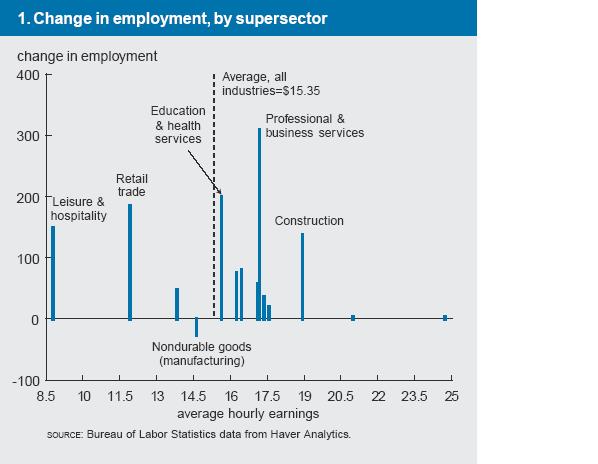
...across a variety of payroll survey calculations, job growth seems to be occurring in high- and low-wage sectors in a fairly typical way given where the economy is in the employment cycle.The authors note that while the graph above looks like most of the growth is in above-average wage areas, finer breakdowns of the industrial areas (2-digit NAICs instead of 1-digit, if you really must know) make the pattern look less positive. Still, the Kerry claim that job quality has been poor during the expansion is at least debatable; this expansion has been quite normal in the quality of jobs generated.
Legislators decide what is principles of economics
Can you say barriers to entry?
We non-profs are only institutes of our higher learning, not of someone else's higher learning. This is not uncommon, actually, as a graduate student can only transfer up to nine hours to our Masters program - but only if the grad studies committee of the department approves.
I hear many requests for transferring of economics courses at SCSU. Many of these are from international schools where we sometimes have trouble reading the transcripts. (Luckily, in a department with eighteen faculty, we've got most of the major languages covered.) My view is that it is our program that is represented by our graduates, and we have some right to be sure they know what they're supposed to know. Does a public university academic department have a right to control its own brand, or does it not?
I suppose if they can make Microsoft a public conveyance, why not?
Tuesday, September 21, 2004
Update on newspaper bias paper
Again, let me be clear -- if the LH results are correct, all they really mean to me is that coverage of economic events under Clinton differed from that under Bush pere et fil. Calling it bias is conjectural. Worth noting -- does it differ between the two Bushes? I don't think LH checked.
I've got this lump, you see
When you live in Northwest D.C. and work in Bethesda, two areas populated by wealthy white folks who share a certain political outlook, you can expect to find another species clinging tenaciously to these dominant beings, just as the cleverest birds of the Serengeti travel on the backs of mighty elephants. I refer, of course, to the humble canvasser. Yesterday, I spotted two examples of Nader fundraiserensis, commonly known as the "perky PIRG provacateur."
"Have a moment for public health?" they asked politely but, despising public health as I do--"buboes for everyone!," that's my motto--I declined and hurried on.
And people wonder why I eat lunch in my office. Quick, check the camera!
Yeah, I had to look up "buboes". Jeff's been to some weird places.
It's the time of the sea-ea-son for protesting
On October 2 at 5:30 at the Husky Stadium, there will be an Educational Rally on Racist Mascots and Logos sponsored by several student organizations on campus.
... Please meet at the American Indian Center at 4:45 p.m. for Pizza and Sign-Making.
I had no idea pizza was a Native American food.
Of course, guess which team is coming to town that night for a football game?
Showing their stripes
I don't need to move to Minneapolis. I can have their kind of government right here.
(Note, links die at end of day. The Times web site has yet to learn static URLs.)
Yeah, I know still
At some point I will need to change the background to two pictures to frame in. I had a different idea for how this would work, but to no avail.
Any additional ideas surely welcomed.
Monday, September 20, 2004
Rathergate: Who is �Deep Gloat"?
Following Dan Rather�s �apology� today on the CBS Evening News, who do you believe is responsible for actually fabricating the forged documents faxed from Abilene, Texas?
a) Karl Rove.
b) Mark Racicot, Chair of the Bush campaign.
c) DNC Chair Terry McAuliffe.
d) Officials and/or minions of the John Kerry campaign.
e) Officials and/or minions of the Ralph Nader campaign.
f) Dan Rather, himself.
g) Dan Rather�s daughter in Texas.
h) Mary Mapes, Texas-based producer of CBS News.
i) Bill Burkett, himself.
j) King Banaian, PhD.
k) Some other blogger.
l) Someone at a competing news organization.
m) Other, please specify __________.
Worker protection from Republicans
A customer came through my coworkers lane on Thursday and said, "Oh, I'm so sorry you could not get off work this morning to go support President Bush. Isn't it great that we have a pro-life president? He is such a blessing to our country."
All my coworker could do is smile and say, "Thank you. I hope you have a nice day."
How would the customer have reacted if the person standing behind the counter handing back her change had told her that he did not think President Bush was a blessing to our country, that he did not support the president and his administration, and then proceeded to ask how President Bush could be both a pro-life and death penalty supporter? Most likely, she would have been insulted.
But people who are working do not get the benefit to say how they really feel without jeopardizing their jobs.
And your point is ...? You have freedom of speech while someone else is paying you to serve customers?
Get thee to the co-op, dear.
Most people are just trying to make small talk, but assuming that others will agree with certain political views is ignorant and not fair to those who feel strongly about their own politics. Please don't compromise my beliefs just because I'm punched in.
Please don't take your employer's money with that attitude, either.
Yeah, I know I stink at design
Sunday, September 19, 2004
I hope this is the new template
Jo's cigar tally: 3.
Fraters' award tally: 0.
We're also going to switch the comments email to comments at the domain name. I'll put up that link shortly. But LS is ringing the dinner bell, and I am hungry. Let's flip this switch...
Apres diner: That appears to have worked. Now I may thank my major helper, who's logo now graces both the Fraters' right column and mine -- Derek Brigham. His is the background design only -- any other problems on this site are the result of yours truly falling asleep repeatedly while reading HTML for Dummies. Thanks for the spiff-up, Derek!
Friday, September 17, 2004
An explanation but no excuse
Luckily, I'm not on NARN tomorrow. Lucky for you too, I guess.
Part of the routine of my day is to check traffic and linkage after lunch, but today not so. A reporter from the STrib called for a quote about some rental ordinance down in Minneapolis. I spoke to him from a dealership showroom while getting my car's oil changed after lunch. Ran back to the office, started on schedule and then given a personnel situation. When 5:00 came the choice was to work until seven and try to make some headway, or go with my friend for a beer at a smoky joint I hadn't been to for a couple of months. Not a hard decision.
Got home, visited with Mrs. B and the LS, and toddled down to the family room about an hour ago. Bring up my counter page. Holy shit! Click the last guests.
http://www.lileks.com/bleats/index.html
NO. The busiest day of the month, and I miss his linkage? Yep.
(At the blogger party last month, King Banion opened my fridge and asked �does it always look like this?� It does. I have a shelf devoted to sodas, and every day they get replentished so there�s always a full assortment. Do all the labels face the same way? What do you think?)Yeah, I noticed, but that's how the name's pronounced by Americans. (Armenians wouldn't even spell it that way, but that's how Immigration spelled it, and as long as they let you in they can spell it any way they like.) I also noticed today I was getting comments from people I had never seen before. I hope some will stick around.
Last night several NARN members received very kind praise from designer/blogger Derek Brigham.
NARN and Hewitt have inspired Jr. Varsity blogs like myself at FreedomDogs to sprout up around MN and the rest of America, and for the foreseeable future, they will only get stronger even if many of them only reach 25 people a day.
...What story will they explode next? Tune in and keep surfing. Who knows, you could be the specialist that contributes the next piece of otherwise useless information to a story that changes the world.
You're right, you never know. One night you've got your head in somebody's fridge being a smart-ass because it doesn't look like your Ghostbusters-lab-wannabe fridge, and the next thing you know a bunch of new friends are reading your blog.
So, after all that, thanks James. Don't forget the Ani in the closet. I'll bring more next time.
In lieu of your macroeconomic review today...
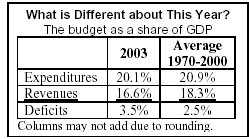
Liberals look at this chart and weep; conservatives rejoice. As I pointed out a few days ago, the only way for liberals to stop spending your tax dollars is to not give it to them.
Interested readers should turn to CBO for more information.
Here's a second graph, in which we can see what has happened to spending. The amount of discretionary spending in the '04 budget is only 39% of the total, down from 45% twenty years ago. Clearly the major culprit in this is Medicare/Medicaid, as you can see below. (Click the graph for the rest of this GAO report.)

While I'm writing this I got David's latest emailed updatewhich quotes Churchill, "We contend that for a nation to try to tax itself into prosperity is like a man standing in a bucket and trying to lift himself up by the handle." The deficit is the result of choices put in place before Bush arrived, the force of demographics and promises for Medicare/Medicaid.
It's also the result of a decision to give money back to people.
One party wants to get that money back.
While we're talking about polls
Reflecting a national trend that shows Sen. John Kerry's support slipping so far this month, polling by Zogby International for the Arab-American Institute found that Mr. Kerry's support has dropped from 54 percent in July to 49 percent among Arab-Americans. In July, 24.5 percent of Arab-American voters said they would vote for Mr. Bush. Now, 31.5 percent said Mr. Bush deserves to be re-elected.
The Investors Business Daily story (subscribers only, sorry) carries this bit of information:
Pro-Kerry Arab-Americans
Why they support him
Vote Democrat 7%
Taxes/domestic issues 17%
Foreign Policy 11%
Like him personally 3%
Oppose Republicans 50%
With Muslims, the poll was 70-3 for Kerry, so Bush's gain was mostly from Arab Christians, who make up 28% of those polled.
The poll, taken in four key states -- Michigan, Florida, Ohio and Pennsylvania -- doesn't differ much when Ralph Nader is included.
Additional thought on polling
To model the likely electorate, researchers used a weighting method based on a model developed after the 1996 and 1998 elections, and tested on all general elections since 1996. It weights each respondent on a combination of demographic, attitudinal and behavioral questions correlated with voting. The individual questions measure income, certainty of voting, having voted in the last presidential election, and registration status.
I wonder why they've not updated the model with data post-1998? It would seem to me that issue saliency vis-a-vis income, for example, would be different between 2004 (when one candidate is proposing big tax cuts and the other big spending increases) would be different than it was in 1996 or 1998. Voting behavior in time of military conflict also would be different. Out-of-sample prediction is hard enough without biasing the sample with elections that look nothing like the current one. This could be a source of the poor forecast performance Trunk is talking about.
Bummer of a birthmark, Hal
Tired of dodging cars as she crossed Connecticut Avenue near her Chevy Chase home, Samantha J. Nolan took the problem into her own hands.Questions abound, such as"
Nolan lobbied the city to study pedestrian and motorist practices at two intersections where crosswalks connect busy stretches of shops just south of the Maryland line. And she got results -- in the form of a program called Safe Steps, a street crossing system that provides colorful hand-held flags pedestrians can use to signal drivers to stop for them in crosswalks
...
Nolan said the intersections have been the sites of several close calls in recent years between motorists and pedestrians.
Safe Steps is "low tech. It's low cost. And it has a high rate of success," she said.
The flags hang from holders on utility poles at the corners of the intersections. Instructions are posted on the poles.
Nolan frequently shows neighbors how to use the flags, teaching them to make eye contact with drivers and to hold the flags so motorists can see them. She advises them to walk to the center of the street and do the same with drivers in the other direction, then place the flags back in their holders.
- What constitutes a "high rate of success"? Is the rate less than 100%
- If you make eye contact with the driver, with or without a flag, how likely is it that you get hit?
- Who needs instructions? And in which languages are the instructions?
Thursday, September 16, 2004
Rather academic
Suppose further that you�re among the more than 90% of those elite members of academe who would love to verify any working hypothesis that would discredit an accepted conservative theory with which you disagree.
Perhaps you�ve had an especially zealous research assistant working for you for the past dozen years or so. Oh, let�s call her Mary. And let�s say that she�s been working for five years to find data that might discredit - not the tenets of an entrenched theory - but rather the personal reputation of the lead proponent of an opposing, established theory. Maybe Mary has had recent success on another research project earlier this year. Why, she seems almost intoxicated by the national attention she has won.
Now you receive a fax of new data from the only Kinko�s in Abilene, Texas. Let�s say that a man, perhaps named Bill, actually faxed it to you.
The documents and data are dated more than 30 years ago. It seems too good to be true. You think, �EUREKA!� Your working hypothesis may not be confirmed. However, the personal data you receive cast doubt on the credibility and integrity of the leader of the theory that is diametrically opposed to yours. You rapidly write up your findings and decide to self-publish it, rather than sending it to a journal staffed with peer reviewers.
Within hours a brigade of pajama referees determines that the faxed documents that you received have obviously been fabricated. You suspect that your research assistant, Mary (who had previously acquired a notorious reputation for having distorted facts in Seattle), may actually be the one who forged the documents that were faxed to you by Bill.
You�re an established, tenured professor, supposedly committed to academic integrity. But questions keep you awake at night. When might the end justify the means? Is it right to turn in a loyal research assistant whose beliefs parallel your own?
What would you do, Dan? What should you do, Dan?
Heinz Kerry revises Maslow
Teresa Heinz Kerry, encouraging volunteers as they busily packed supplies Wednesday for hurricane relief efforts in the Caribbean, said she was concerned the effort was too focused on sending clothes instead of essentials like water and electric generators.
"Clothing is wonderful, but let them go naked for a while, at least the kids," said Heinz Kerry, the wife of Democratic presidential candidate John Kerry. "Water is necessary, and then generators, and then food, and then clothes."
I kind of get what you mean, Madame, but first of all they're donations, and second of all your husband has enough trouble without having you prattle on with "Let them eat generators."
Dueling polls
"Both polls could be right." ... The differences are within the margins of error of the two polls. He also noted a slight difference in the times the polls were conducted; that the two polls have different ways of identifying likely voters; and that undecided voters tend to change their minds frequently.
"It's a tight race, and it can go back and forth almost every day," Frank said.
Steve's got loads of experience, so I'm willing to believe he's right about this, but it's jarring to think that you could change a poll by 11% by changing how you filter your calls down to likely voters. (If you're reading Steve, you have the floor. I'd like to learn about this.) Also, the MOE of the PiPress poll is 4% and that of the StarTrib is 3%; the difference being 11%, I am not sure Steve's right about these two polls not being statistically significantly different.
To its credit, the STrib has a description of its polling method along with the caveat that they had a higher number of people willing to respond to their callers than usual for Minnesota. The description of the PiPress/MPR poll is here. That page included the result that 23% of respondents "had concerns about what Kerry did" in Vietnam, while 14% had concerns about Bush's service.
Meanwhile, Mitch notes today that the national polls show higher negatives for Kerry than Bush; the StarTribune today states that half of its poll respondents believe Kerry flip-flops.
Crack campus paper off to roaring start
'We will make sure our troops have all that is necessary to complete their missions. That's why I went to Congress last September and proposed fundamental-supplemental funding, which is money for armor and body parts and ammunition and fuel,' Eerie, Pa., Sept. 4.Shouldn't the freshmen have to work their way up to the editorial page?
Yellow bike update
"We haven't gotten any complaints to this point but we've had two bikes that have been damaged," [campus rec director Tom] Heck said. "One is repairable but the other one is completely shot so we'll strip it for useable parts. We kind of thought there would be some vandalism, but other than those two bikes, there haven't been any real problems."
The issue of vandalism is one that [student Eli] Watson found disturbing, and while only a freshman, he believes that the majority of his fellow students are better than the one or two people who found it necessary to damage the community bikes.
"When something like this is made available to students at no charge, I just can't understand why they would act like children," Watson said. "Even though this is only my first month of college, I think college-aged students should be able to handle something like this with maturity and respect."
Seriously, son, take an economics class.
This paragraph is even more remarkable.
"Honestly it's an honor system," Heck said. "If a student lives in a residence hall and they work at Taco Johns downtown and want to ride over there, we don't care. Like I said it's an honor system and we'd love to see students keep the bikes on campus, but if they want to go downtown for a haircut or groceries, that's fine."
Why not just hang a sign on them that says steal this bike?
Students are not customers
[L]ike any good parent, I called the principal's office at my local public elementary school to check it out before sending my son. Alas, despite spending $20,000 per child, our school had trouble returning three phone messages left during normal business hours. On my fourth try I reached a live person, and had a brief conversation:
"Hi, I'm Bob Maranto. I'm a parent who lives in [your school's] attendance zone. My son will be old enough for kindergarten next fall. He's actually right on the edge, so he could go next fall or the following fall, and I was wondering if I could come visit the school sometime."
"We don't have any visiting this year," the administrator replied. "We're doing construction and a lot of things are going on."
"Could I watch a class in session?"
"No, even when there's no construction you could not watch a class."
"Well, could I meet my son's teacher?"
"No, the teachers are busy teaching all day and then they go home."
As we used to say when I was in government, this is customer service worthy of the Internal Revenue Service. It also corresponds to playground gossip about this school, which has test scores lower than nearby schools.
A mere five months and 22 phone calls, faxes, and e-mails later--to the superintendent, school board, principal, and various other "public servants"--I was allowed to visit my son's likely school. Someday, I hope to watch a class.
But must it be so hard? Why not open public schools to the public?
As the writer points out, not all public schools are like this, particularly when public school choice is available to parents.
After seven years of research, I'm convinced that Arizona public schools cater to parents because of school choice combined with heavy reliance on state funding rather than local property taxes. Unlike most states, Arizona has open enrollment across district lines as well as 500 charter schools--many started by teachers--so parents unhappy with one school can easily find another. In addition, state funding means that education dollars follow enrollment, so schools that alienate parents lose money--which in turn alarms school boards and makes principals unemployed.
In response to competition, particularly competition from charter schools, Arizona public schools increasingly offer Montessori options, back-to-basics programs and a wide range of other innovations to keep parents from going to other public schools and taking state dollars with them. And they do all this on budgets far less than in my state [Pennsylvania].
Lucky for us, Minnesota has this type of choice as well.
Wednesday, September 15, 2004
Dueling economic policies
This isn't much of an economic plan in my estimation. Its a "I'll do it better" plan built on a mischaracterization of where we've been (recession, 9/11, war) and where we are (1.7 million new jobs, 5.4% unemployment, increased productivity, total compensation up, and the highest homeownership percentage in the nation's history).McQ's second piece at QandO takes up the claim that Bush's economic plan spends more money than Kerry's. Privatizing Social Security and tax cuts are cost when you think the money belongs to the government. As a wise man once said,
...how can we ever cut government down to size? I believe there is one and only one way: the way parents control spendthrift children, cutting their allowance. For government, that means cutting taxes. Resulting deficits will be an effective--I would go so far as to say, the only effective--restraint on the spending propensities of the executive branch and the legislature. The public reaction will make that restraint effective.How much of Bush's plan is tax cut and how much is spending increase? How about Kerry's? The Globe article McQ critiques didn't make the distinction.
And there's never been a Hurricane King
I have never understood the naming schemes anyway. In the Atlantic, where storms are likely to hit the American continent (speakers of Spanish, Portuguese, and English) and never hit Europe, many names are in French, Russian, and Swedish. For the eastern Pacific, where the storms will either hit Central America, Mexico, or move out into the ocean, there are several Italian names in the cycle.My friend has not had a hurricane named after him, according to this list he sent.
In the western Pacific, where the strongest storms are likely and they hit Orient, the names tend to be English. I can just imagine some Chinese meteorologist trying to pronounce "Bert" or "Fred".
Start of leftist conference season
Meanwhile back at the ranch, our near neighbors at St. Johns and St. Bens are having a peace conference in which one session isn't doing much for female unemployment rates:
�Women in the Military: Is it Equality or Assimilation?� presented by Chante Wolf and panel of veterans. Looking at the job opportunities for women in the military. Is the military really a job opportunity or assimilation to growing violence, through coercion, intimidation, physical and mental violence, misogyny, homophobia and racism as the core to military discipline? What makes a woman proud to be: an F-16 fighter jock known as "killer chick"; photographed with a smile and thumbs up with an Iraqi POW corpse; a medical corp person who knowingly with held information about prison abuse; or a combat veteran?They should invite Trunk, but he might be busy with TV and all that.
Miraculously, the local Amnesty International chapter on campus has decided to protest Darfur instead. I'd be delighted to agree with them, but I'm leery.
Prelude to Kerry on the economy
Tuesday, September 14, 2004
Too productive for their own good
Productivity has grown right through the downturn and into the incipient recovery. A 1 percent increase in productivity eliminates the need for about 1.3 million jobs. Of the 2.7 million jobs lost over the past three years, a million were lost within 90 days after 9/11, and only 300,000 resulted from outsourcing. In 1990, America had 169,000 steelworkers. Eleven years later, that number had been cut nearly in half--but those workers produced 17 percent more steel. The long-term trend for manufacturing employment has been downhill for at least 25 years, and it won't be going back up again. This is true not only for America but for the world's 20 largest economies. We lost 11 percent of our manufacturing jobs; the Japanese lost 15 percent; Brazil lost 20 percent. Even China lost 15 percent. Why? Higher productivity.Zuckerman argues that this was an opportunity missed by John Kerry. Question raised: Is it possible that an economic policy could increase productivity too much for its own electoral chances? If we could get away from Memogate, Swiftees and the rest, this would make a fascinating topic.
Consumption taxes
President Bush will work with Congress to make the tax code simpler for taxpayers, encourage saving and investment, and improve the economy's ability to create jobs and raise wages.
The only difference here from John Kerry would probably be the "encourage saving and investment", which in Kerry's version seems more focused on making sure that the investment comes from overseas revenues of U.S. multinational firms. Indeed, Kerry's plan, which is argued to be a tax cut for corporations, isn't when you see how it's paid for.
The Kerry-Edwards plan saves an average of $12 billion annually from eliminating the ability of companies to defer taxes on foreign income and closing corporate loopholes. These savings are all used to cut corporate tax rates by 5 percent.
Now, this is not a bad idea -- lowering rates and flattening tax bases is consistent with the types of reforms in the 1986 tax act passed by Reagan and the Congress. It might make firms more efficient, but it's not clear to me at all why incentivizing firms to pay for investments by cannibalizing their international operations is a sound economic plan.
In contrast, according to the Business Week article, there are whisperings that a second Bush administration would operate on individual taxes by allowing greater deductions for savings. Jim DeMint in South Carolina is running on a platform that includes a national sales tax. Reading former Bush Council of Economic Advisors Chair Glenn Hubbard's editorial in the WSJ last week sounds like someone else is thinking the same way.
Tax policy can play a significant role in encouraging--or discouraging--entrepreneurial risk-taking. It is startling how many entrepreneurs starting a business are subject to the individual income tax (as sole proprietorships, partnerships, or S corporations). Because entrepreneurship is a risky undertaking, prospective entrants evaluate possible after-tax returns from success and failure in deciding whether to start a business. The income tax weighs in because the government is not an equal partner in success and failure. While the government does not grant a complete offset for business losses, the progressive income tax imposes a "success tax" on a good outcome. If this success tax is high enough, a
prospective entrepreneur may forego a risky venture to continue working for
someone else.How important is this effect. Using data on U.S. households, William Gentry and I found that the "success tax" has a potent negative effect on entry into entrepreneurship. We estimated that President Clinton's 1993 tax increase, which raised substantially the top individual income-tax rate, reduced the probability of entry for upper-middle-income households by as much as 20%. Should Mr. Kerry reverse the president's tax cuts, that estimate suggests an important hit to new
entrepreneurial activity.
Skeptics should wonder why Bush is being vague about this, if this is indeed in the second Administration's plans? Two reasons occur to me. First, it will attract a lot of flack from Democrats. There is an argument that national sales taxes are less progressive than income taxes, which the BW article points out. States have long understood this: In Minnesota this is handled in no small part by exempting items like food, clothing, or prescription drugs. And DeMint is taking some heat for his proposal.
Second, implementation would be quite radical. I remember a conversation over twenty years ago when, as a grad student working as a driver for a conference on Reaganomics, I took Jerry Jordan to the airport. Jordan at that time was on Reagan's CEA. I asked about proposals for value-added taxes in the States. (These proposals have been around for nearly fifty years.) He replied it was a political problem: Good policy would be to replace the individual income tax with the VAT, but he feared the Congress -- controlled by Tip O'Neill at the time -- would accept the VAT but not repeal or adjust the income tax. Better not to bring it up at all.
Again this is all speculative, but if Bush has such a plan in mind it would be as revolutionary to economic policy as the Bush Doctrine has been to foreign policy.
Leading the student
One of the more striking examples took place in Room 201 on Thursday afternoon at Washington High School in San Francisco, where teacher Martin Wolf deftly transformed a discussion of plot, setting and character in "The Lion King" into a focus on plot, setting and character on the world stage.Ri-i-i-ight. Planting the seeds.
"In Iraq, we also have a setting," Wolf told the 10th-graders in his ethnic literature class, pointing out that the conflict, complications and climax of fiction are no less present in Baghdad and Washington.
"Yesterday, George Bush said that the 1,000 soldiers who have died in Iraq died fighting terrorism," Wolf said. "I wonder -- did they? Does George Bush believe this? Let's go back . . . "
He then recounted the events since Sept. 11 using slides filled with facts, photos and the vocabulary words "mujahedeen," "theocracy" and "secular."
. . . Later, Gwendolyn Samson, 15, said she found the lesson valuable because she hadn't known that Iraq was not responsible for Sept. 11.
Students like Gwendolyn were his "target audience," Wolf said -- the reason the lesson was important.
"We need to be an informed citizenry," Wolf said. "I'm planting the seeds."
And since when did 10th grade literature start using the "Lion King" as a text?
And we're the land of 10,000 Petersons
I have a class of 21 students. 7 of the 21 have a last name which starts with the letter B.
I find this odd.
Seriously, I went six years at SCSU before having one class without at least one student named Peterson or Petersen. Two of the staff workers I work with regularly carry those names as well.
More seriously, there are frequency tables for letters in the alphabet, but is there one for last names?
Good pipes
As James reported today, Gnat was in tow, and I had to whip out the camera phone for a shot. Gnat understands property rights, unlike Sam who's possessed her iBook. This accounts for Gnat's ho-humminess. Sam will receive a copy of Steal this iBook soon.
She reports, you decide
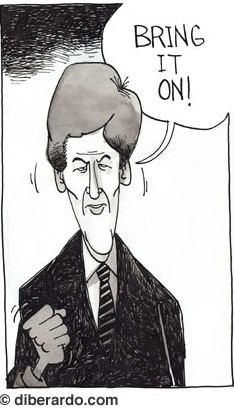

Someone tells me the voice of the Crimson Chin is Jay Leno. Him, I'd vote for.
Monday, September 13, 2004
How many Floridas?
It ain't over until 538 fat ladies sing on December 13th. If then.
You could just take this guy's advice.
Don't link to this guy until he links to me OK, he's fine now
So... who's the one guy of the NARN that Duane doesn't link to?
UPDATE: Elder notes me as the Tom Bodett of the NARN. Did you notice where he lives?
Bodett lives between his homes in Homer, Alaska and Vermont.
Close enough to St. Cloud and New Hampshire for me.
UPDATE 2: Capitulation! Behold my power.
Kicking over your strawmen
This paper develops an econometric technique to test for political bias in news reports that controls for the underlying character of the news reported. Our results suggest that American newspapers tend to give more positive news coverage to the same economic news when Democrats are in the Presidency than for Republicans. When all types of news are pooled into a single analysis, our results are highly significant. However, the results vary greatly depending upon which economic numbers are being reported.AEI, being a DC think tank, knows how to promote its work and so put on an event on media bias today complete with discussants and some more presentation materials. But the NYT doesn't wait for the presentation to discuss the paper, and instead assembles a panel of pooh-pooh-ers. Craig Newmark is much more succinct than I would be:
The piece concludes with a vicious insult of Lott by Professor Brad DeLong. Note that the insult implicitly criticizes the editors of the American Economic Review, the Journal of Political Economy, the Journal of Law and Economics, and all the other top economics journals John Lott has published in, journals that presumably wouldn't publish the work of "right wing hacks".That's right, one of the authors of the article is John Lott, and that in and of itself constitutes a positive defense in DeLong's view that the article proves no such thing as media bias. (Proving that two can play that game, Don Luskin strikes back.) The other author is Kevin Hassett of Tech Central Station fame. Are we to assume that he was duped into this research by Lott?
All this, over an unpublished article.
The NYT has done a disservice here. We've discussed this type of research before; the nature of the research is empirical, and subject to debate and review. Lott and Hassett's research is in need of scrutiny, and placing it on a site like SSRN, where working papers are published to be read, reviewed, dissected, and more than a few sent to oblivion by insightful rebuttal, invites that. In the double-blind process the paper would be reviewed without knowing the identity of the authors, precisely to stop the ad hominem attack of De Long, et al. And the paper could use it; I've read it very quickly this PM, and I think the econometric results need much better explanation for why the joint results work so much better than the results for individual economic news sources. Really reading the paper though, is hard work, and it doesn't appear any of the commenters have done so. And the NYT doesn't address the fact that a second paper on the topic comes to roughly the same conclusion.
If Brad wants to be pissy on his own blog, that's his prerogative. (If you technorati this article, you will find several lefty bloggers engage in the same type of attack: "Oh you won't believe what Lott's up to now!") But the point of the paper is that each side of the ideological divide believes the media is biased against them, and you would think both sides would want to hold a reasoned debate on which view is right (and perhaps neither is.) The NYT has hindered that exploration.
In the process, they've added a datum to Lott and Hassett's information set.
On Prager today
I'll be with Mitch, Elder, Big Trunk, and special guest James at Dennis Prager's show noon-3 ET (9am PT, and elsewhere...well, figure it out). We hope you will tune in, on the air or on the web. I expect we'll discuss more on the memos and the changing of MSM.
I don't know if I'll get to talk on the last topic there, but be sure to look at Steve Horwitz' thoughts on how diffused knowledge (or what Hugh is calling "open source journalism"). An example:
... when one sees oneself in an environment of competition, as bloggers do, one cannot afford to be lazy and everyone has to start checking their premises. This is not ... an attempt to police people's politics. Rather it is competition doing what it does best: holding everyone accountable to the "constitutional rules" of the Republic of Science. And as good Hayekians know, when the rules are right and access is open, the truth will out.You could just read Hayek. Nevertheless, the nature of the competition is that both MSM and bloggers will be improved by it, changed by it. And while my nightwear choices are my own business, it's hubris to be lulled to fat-and-sassiness by declarations of becoming players (a view I share with Elder, it appears.)
I'm sure I'll have more thoughts driving back and forth. See you tonight.
Retrospective voting -- how the Democrats wanted it
The Democrats chose a candidate known for political calculation, a talent for nuance and an unswerving dedication to swerving constantly to avoid political risk. In other words, they chose a cipher.I can see why one might run such a campaign, if the economy was bad, the war going poorly, etc. But it wasn't. And when you run a campaign like this, you are left with this:
Not a bad strategy when the news for the Bush administration -- the Iraq insurgency, Abu Ghraib, the Sept. 11 hearings -- was awful. Pick a cipher and make this a referendum on the president. A plausible idea, but it did leave everything up to chance. Worse, it leaves everything up to the other side.
Democrats had hoped that their convention in Boston would introduce Kerry to voters and give them ample reasons to support him. But the survey suggests that those efforts did not succeed. A majority of those voting for Kerry -- 55 percent -- still say they are voting against Bush, not for Kerry. Barely four in 10 said their vote was more for Kerry than against Bush -- a percentage that has changed little since March.There has been throughout this campaign a fascination with the number for job approval. The number has moved to the 50% level in the last two weeks. And with it has come the bounce. Krauthammer tempers our enthusiasm.
"I'm more anti-Bush," said David Kolker, 37, of Creve Coeur, a suburb of St. Louis. "I really don't think Kerry has a chance -- he has not really taken a stance as far as defending himself against Bush."
In contrast, more than eight in 10 Bush voters say they are casting their vote for Bush and not mainly because of concerns over Kerry. And nine in 10 say they strongly support the president.
Will the bounce last? Undoubtedly not. The Bush lead will narrow. But it will not be Kerry doing the narrowing. It will be the world. Bad news is always out there. In the middle of a middling economic recovery, there is always bad economic news to accompany the good news. And the fighting in Iraq will continue to haunt this presidency.And there's not much on the economic calendar between now and the debates. Either Kerry has to catch fire in the debates, or he has to hope the real world throws pot holes in front of Bush's drive to re-elections.
Bush will slide. Kerry will surely fight, but he will mostly flail. He has become a spectator. This election was and remains a referendum on Bush. That's how the Democrats wanted it.
Sunday, September 12, 2004
Sunday morning musings
Who am I?
a) Marcia Clark.
b) Dan Rather.
Who questions me?
a) Johnnie Cochran and Alan Dershowitz.
b) Scott Johnson and John Hinderaker.
Please keep up the pressure, gentlemen! A truly free society demands that our fourth estate . . . as well as our judicial branch . . . must be held to the highest standards of integrity.
For daily updates, please bookmark: http://www.powerlineblog.com/
Friday, September 10, 2004
Macro updates
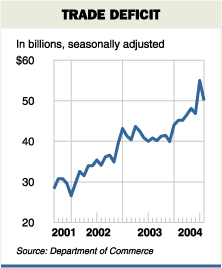
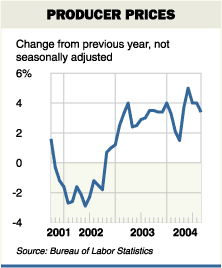
The news everyone has focused on is the latest initial unemployment claims figure, which came in as down 44,000 from previous week, which was more than double the decline expected. As Captain Ed notes (Ed's muscling in on my turf, man), each week we get better news on the unemployment level, the better things go for Bush -- Kerry cannot really run on "the worst economy in XX years" when the numbers keep showing an improving economy.
And I wonder how much it really matters. I thought of this looking at this graph from a publication at the St. Louis Fed.
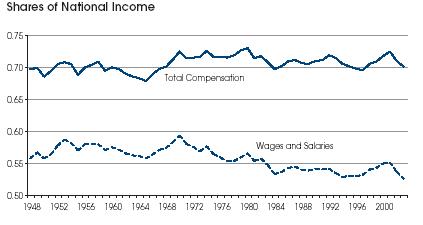
That figure is the share of labor in national income, as measured either by wages and salary alone, or by the toatal compensation package, which includes the employer's contribution to Social Security and employer-paid benefits. Democrats will point to the dashed number, of course, because that last jog downward takes you to a leve we haven't seen since WW2. But when you look at the top solid line, you can see that we have total compensation running about 70-72% of national income, as it has for the entire period (the average is 70.5%). And this doesn't even pick up how we allocate proprietors' income -- if, as the debate over which labor survey is correct argues, we have more self-employed workers than before, perhaps some of what we're calling the share paid to capital is actually paid to labor. The way the statistics are done currently, you divide proprietor's income into labor and capital components at the same rate as the rest of the economy. If more workers are proprietors or independent contractors in small, service sectors, we may be over-estimating the share of income that goes to capital.
Bottom line: If workers give employers credit for putting money in their benefits package, then they probably feel no worse off now than they were four years ago. Subtract another issue for the challenger.
Let me also call attention to this Economic Letter from the San Francisco Fed, which gets into the dueling employment surveys debate. Read the whole thing, but particularly the last two paragraphs, in which the author argues that the household survey might be the one with greater problems than the payroll survey, as the household survey's reflection of self-employment to them is an indication of weakness on the job market, not strength. Think about it, and put something in the comment box. I don't think I agree with it, but I haven't read the underlying studies yet to be sure.
In case you're wondering if I've been reading the Powerline stories on the memo forgeries, the answer is yes. I also watched the Tradesports number on Bush's re-election. It went from 58 to 62 early in the week to Wednesday, slid to 61.7 close yesterday, and currently is trading at 64.1. There's lots of support on the book right now above 61, and nobody selling under 65. Kerry hasn't been above 40 for days. The memos, if anything, have backfired. IEM has Bush trading above 55. On the state markets on Tradesports? Buy Pennsylvania, where you can land Bush contracts at 43-44 while Gallup has him up 1, and Minnesota 39-40 (a thumb for Zogby's eye).
What should economists do?
What is the sophomore, who has completed his "principles," expected to reply to the question: What is the difference between an economic and a technological problem? He might respond with something like the following: "An economic problem arises when mutually conflicting ends are present, when choices must be made among them. A technological problem, by comparison, is characterized by the fact that there is only one end to be maximized. There is a single best or optimal solution." We conclude that the sophomore has read the standard textbooks. We then proceed to ask that he give us practical examples. He might then say: "The consumer finds that she has only $10 to spend in the supermarket; she confronts an economic problem in choosing among the many competing products that are available for meeting diverse ends and objectives. By contrast, the construction engineer has $1,000,000 allotted to build a dam to certain specifications. There is only one bet way to do this; locaiting this way constitutes the technological problem." Most of us would, I suspect, be inclined to give this student good grades for such answers until another, erratic and eccentric, student on the back row says: "But there is really no difference."
And there's not. Both are optimizing subject to constraints; the only difference is that the constraint is better specified for the engineer than the consumer. Over time, some economists have tried to make the consumer's problem look more like the engineer's, because that problem is tractable; you can see yourself grinding out a mechanical solution. There's no choosing.
This type of criticism of economics has been around for a long time -- Buchanan understood it forty years ago. He later said in The Limits of Liberty:
If something is wrong, have government regulate it. If the regulators fail, regulate them, and so on down the line. In part this is the inevitable result of public failure to understand the simple principle of laissez-faire, the principle that results which emerge from the interactions of persons left alone may be, and often are, superior to those results that emerge from overt political interference. There has been a loss of wisdom in this respect, a loss from eighteenth-century levels, and the message of Adam Smith requires reiteration with each generation. (Modern economics must stand condemned in its failure to accomplish this simple task, the performance of which is, at base, the discipline's primary reason for claiming public support.) (Emphasis added.)
You might by now wonder why I bring this up (if you haven't already left). A couple of days ago Edward Lotterman published an article that started nicely enough discussing "social capital":
To some, that is simply stating the obvious, but Harvard Professor Robert Putnam has gained considerable fame with these assertions. For more than a decade, he has tried to measure such "social capital" and determine the degree to which it influences various social and economic outcomes. A talk he gave Wednesday in Minneapolis prompts insights on the limitations of current economic research.
It also raises questions about what, if anything, a community or nation can do to raise the level of civic engagement if such engagement in fact makes society better off.
Putnam spoke to a meeting of the Great North Alliance, an organization of leaders from business, labor, government and academia dedicated to improving the competitiveness and quality of life in the Twin Cities.
I highlight the identification of the group because it's telling. (The links are also my insertions, just in case you want to research this.) One wonders how these people thinkg they can "improve competitiveness". I'll come back to that, because I have another ax to grind first with Mr. Lotterman first.
Many economists are not convinced, largely because their discipline long has scorned consideration of such subjective factors as "social capital" or "civic engagement" in their theorizing. Their tepid response to scholars such as Putnam says more about the limitations of contemporary economic theorizing than about the validity of his ideas.
From the discipline's inception two centuries ago, economists have assumed that economic resources are divisible into land, labor and capital, and that humans are rational beings who make conscious choices so as to maximize the satisfaction they get out of life. Implicitly, most agree with former British Prime Minister Margaret Thatcher who said, "There is no such thing as society; there are individual men and women and there are families."
A bit more than a century ago, three British economists � F.Y. Edgeworth, William Jevons and Alfred Marshall � transformed economics by introducing mathematics as the language of economic reasoning and discourse. After World War II, U.S. economists such as Paul Samuelson boosted use of mathematics to a still-higher level.
The concept of "social capital" though has been researched a great deal by economists. We spend a large amount of time figuring out why some countries are rich and others poor, as Lotterman later says. That discussion has focused not nearly so much on the amount of labor and capital countries have -- because the ratios of inputs held by rich and poor countries cannot possibly explain the differences in living standards -- but on why some countries are so much more productive. Read the work of researchers at the World Bank, or of IRIS (Mancur Olson's legacy). This isn't new work. And we've understood the bad as well as the good of Edgeworth, Jevons and Marshall, as Buchanan noted forty years ago (and, many will argue, Mises and Hayek well before then.) Lotterman isn't just erecting a strawman -- he's trying to rescue one that's been knocked down for decades. And meanwhile, he's rebuilding leftism:
If social capital, culture and institutions are important, can a society do anything to consciously transform itself? Can failing Bolivia transform itself in the image of successful Chile? Could corrupt and ineffective Romania become a bustling Switzerland on the Danube?
But the point is, if you believe competition is the way these countries can become rich, gathering people in some alliance (even NARN) isn't how it's done. Buchanan had that wired forty years ago as well.
A market is not competitive by assumption or by construction. A market becomes competitive, and competitive rules come to be established as institutions emerge to place limits on individual behavior patterns. It is this becoming process, brought about by the continuous pressure of human behavior in exchange, that is the central part our discipline, if we have one, not the dry rot of postulated perfection. ... A general solution, if there is one emerges as a result of a whole network of evolving exchanges, bargains, trades, side payments, agreements, contracts which, finally at some point, ceases to renew itself. At each stage in this evolution toward solution there are gains to be made, there are exchanges possible... (italics in original)
You cannot will social capital. When Putnam notes on his site that "Joining one group cuts in half your odds of dying next year," that isn't cause-and-effect (I'm sure Putnam would agree.) Countries in which people join groups more readily have progressed through these emergences to a place where life expectancy is higher. It's hubris to think we can force these emergences, and economists that do aren't doing their jobs.
Senior year a waste of time?
Virginia Gov. Mark Warner yesterday announced a plan to reform high schools nationwide and make senior year worthwhile.
As chairman of the National Governors Association, Mr. Warner said the yearlong initiative � "Redesigning the American High School" � will make it easier for seniors to earn college credit for college-level courses and improve vocational education so that those who don't attend college can learn a profitable trade.
He said he hopes that the initiative can eliminate "senioritis" and increase graduates' earning potential. ...
"Senior year can sometimes be a waste of time or not fully taken advantage of," Mr. Warner said yesterday, characterizing his plan as "the equivalent of giving the parent a $5,000 voucher."
For those unaware, Governor Warner is a Democrat. It smells a bit of school-to-work, but just getting them to admit that they have students in a year of public school which is "a waste of time" is a wonderfully embarassing admission.
Yard signs -- not a recipient of "tolerance"
Congratulations lefties. You have destroyed more private property, promoted the idea that you only approve freedom of speech when it suits you and further sealed the opinion of yourselves that you have no class, even well outside your more radical, saturated central location. I will be getting a bigger sign soon.
Wait until they get a load of this guy up in Duluth!
At least it wasn't a flag.
Know-Your-University
- Your catalog repeatedly indicates that your college is devoted to creating an ethnically, racially, and socially inclusive campus. Describe what prevents your students from spending every moment of their collegiate lives with people who look, think, and act just like they do.
- Your catalog also indicates your commitment to intellectual diversity. Please state the percentage of your faculty that votes Republican. Please attach the names of outspoken conservatives on your faculty. Use additional sheets if necessary.
- If your school has an honor code, present empirical evidence to demonstrate that your honor code leads to fewer acts of dishonesty at your campus than at similarly-situated universities that lack such a code.
Kern offers twelve other questions. Hat tip: Cold Spring Shops, who answers three questions and asks a different question:
"To what extent does your staffing policy give the impression that there are two classes of faculty, those that only teach and those that have to produce research? Doesn't the existence of a large staff of often contingent teachers belie the Every Teacher A Scholar ideal your publicity promulgates?"
Thursday, September 09, 2004
Giggle snort
Happy blogiversary to me -- we're moving!
www.scsuscholars.com
Now Mitch can't screw up my URL!
Hope this works!
Scholar Dave says...
No substitute for good parenting
Racism continues to exist, he said, but "there is nothing that will defeat parenting." He added: "My call is for more, tighter reins. Know what your
children are doing."
...Cosby told his critics, "Come at me all you want." To those who criticized him for blaming the victim by preaching personal responsibility, he said: "I know a victim when I see one. And so did Christ. And so does God know victims. And so do we all recognize victims. But some victims you can look at and say, 'Get up.'"
The value of the college brand
Some students and their parents have always been obsessed with getting into the best colleges, of course. But as a result of rising population, rising affluence, and rising awareness of the value of education, millions of families are now in a state of nervous collapse regarding college admissions. Moreover, although the total number of college applicants keeps increasing, the number of freshman slots at the elite colleges has changed little. Thus competition for elite-college admission has grown ever more cutthroat. Each year more and more bright, qualified high school seniors don't receive the coveted thick envelope from a Gotta-Get-In.The bomb, which is this paper (well, that's the summary -- the real paper is here in an earlier form for free and published here for subscribers of the Quarterly Journal of Economics 2002), is that it matters much more where you applied than where you actually attended. The implication, of course, is that success in later life is more correlated with the things you brought to college than the things you brought out of it. As Easterbrook points out, the results aren't clear-cut. It may be that working around smarter students makes one work harder, a "peer effect". And colleges will always sell the value of their alumni networks, which might have value separate from the value added by professors. But Easterbrook is worried that students are too stressed out about admissions.
But what if the basis for all this stress and disappointment�the idea that getting into an elite college makes a big difference in life�is wrong? What if it turns out that going to the "highest ranked" school hardly matters at all?
The researchers Alan Krueger and Stacy Berg Dale began investigating this question, and in 1999 produced a study that dropped a bomb on the notion of elite-college attendance as essential to success later in life.
It's understandable that so many high schoolers and their nervous parents are preoccupied with the idea of getting into an elite college. The teen years are a series of tests: of scholastic success, of fitting in, of prowess at throwing and catching balls, of skill at pleasing adults. These tests seem to culminate in a be-all-and-end-all judgment about the first eighteen years of a person's life, and that judgment is made by college admissions officers. ...
Surely it is impossible to do away with the trials of the college-application process altogether. But college admissions would be less nerve-racking, and hang less ominously over the high school years, if it were better understood that a large number of colleges and universities can now provide students with an excellent education, sending them onward to healthy incomes and appealing careers.
I am sure I've plugged this several times but it bears repeating -- parents need to be involved in these decisions, and they need to become informed of what the choices are and what really matters in choosing where their children will attend college. Here's an online book by Thomas Sowell on the subject, and here's ISI's Choosing the Right College.
(Hat tip for Easterbrook link: Orin Kerr.)
Bait and Olson
Nobody with even the most passing knowledge of the Farmer-Labor movement would deny that Floyd B Olson was a socialist by almost any definition. Governor
Olson famously promoted the state ownership of industry and the forcible redistribution of wealth. And for those of you in need of a history lesson, remember that Hubert H Humphrey made his name by driving the communists out of the Farmer-Labor Party when it merged with the Democrat party in 1944.Governor Olson would never have hidden or shaded his political views the way his modern defenders have. He proudly called himself a �radical,� and staked his claim to political office on his willingness to be a radical. �I do not mind being called a 'red' . . . I would prefer it to the term 'yellow',� said Floyd.
And as for Reagan? Apparently it galls aging leftists to even admit the Ronald Reagan was Minnesota�s President too, no less a truly great one. In Eastern Europe Reagan is known as the Great Liberator for his willingness to face down Communist tyranny, and for his contribution to ending the Cold War. According to Nick Coleman, ace historian, Reagan was nothing more than a �thespian.� Coleman couldn�t even choke out the fact that Reagan served as President, no less was a truly great statesman.
Coleman of course is a bobo who married into his boboism but the point here really is that Coleman and the rest of the pained criers have no sense of proportion between historical figures. They cannot rank a president acknolewdged by most as one of the our ten presidents ahead of a leftist icon of Minnesota. They can name schools after Wellstone, but nothing for Reagan.
Harder and harder to get international students
This has been an ongoing problem for ages. Our masters program is such that we can offer aid packages to international students, which is really the only way to get them here. The financial requirements are so large that most students cannot meet them. Embassy officers evaluating visa applications can also be quite difficult -- this may account for the fact that applications from China have dropped 45% according to the article. We have 900 international students at SCSU, and we've had some success through hard work at getting Chinese students to our own program. But yes, it's been getting harder and harder.
Which is more unfair?
Wednesday, September 08, 2004
Sorry about that!
Tour of econ grad programs in DC
I never travelled to Claremont before agreeing to attend there. Had I, I might not have gone because of the smog obscuring Mt. Baldy, but the Village probably would have won me over anyway.
University doings
A colleague at an Ivy League university told me that the year before his retirement the undergraduate classes voted him "teacher of the year." His comment: "Lucky for me, I was on my way out: It would have hurt my career if I won that kind of award as an assistant professor."
It doesn't hurt here; if anything, it should help if you read the kind of message our President Saigo is sending this term. We had two faculty with articles in the local paper (still handicapped with no archiving, so fish for the articles in the opinion section if you're reading this after today), one positive and one negative. Meanwhile, our chancellor is worrying that citizen's committees and the legislature will short-change MnSCU.
What McCormack fails to tell you is that while he's made budget cuts and program eliminations, his own system office budget has risen to absorb more than $1 in every $10 in the system. The cuts to administrative costs are no more there than anywhere else. Perhaps Saigo needs to send an SOS to St. Paul to send reallocate that money back to the colleges. And the chancellor better prepare for war with the U of M over resources.Since fall 2000, full-year-equivalent enrollment at the Minnesota State Colleges and Universities has grown by 18,000 students, or more than 15 percent, while state funding has dropped nearly 6 percent in actual dollars. The per-student state appropriation for the 2004-05 academic year is $3,990, lower than it was in 1994-95. Our dedicated faculty and staff are working hard to maintain quality, but these budget cuts, coupled with increasing demand, are challenging our ability to serve business and community needs and stressing our facilities.
To partially replace lost appropriations, tuition has risen 60 percent since fall 2000, placing an increasing financial burden on students, many of whom can't afford it. Despite significant operational improvements, budget cuts and program eliminations, we are facing an uncertain future and the real possibility that Minnesotans' access to higher education will be diminished.
Figures don't lie, but...
None of these were accidental.
FREEPers do stats
Tuesday, September 07, 2004
Odd calculations.
Again, that's if I have interpreted the price of that contract correctly. I can't see why it wouldn't be correct, but something tells me it shouldn't be that easy. I'll update that number on the Friday macro review each week.
Why a little economics goes a long way
There is a simple mistake that all of these people are making (not Ruth or Arnold, they are arguing against that very mistake) and it is indeed so simple that even left-leaning economist Brad de Long has noted it. If you raise to a company the cost of employing people they will employ fewer of them. More importantly, they will only employ those who are more productive than those higher costs. We would then expect to see the less productive workers not employed at all.This in response to the problem of people arguing that Europe has higher productivity because of its labor market restrictions. Somehow people think because productivity per hour is higher that Europe must be richer. As Worrell and Kling point out, it just isn't so. Bruce Bartlett finishes the explanation.
The OECD blames the unwillingness of Europeans to work as the principal reason for the lower output per worker and their lower standard of living compared with Americans. "Research has clearly established a remarkable fact: namely, that the sizable U.S. advantage in real GDP per capita ... is largely due to differences in total hours worked per capita," the report states. It urges European governments to reform their labor policies to increase work hours, a recommendation seconded in a recent report from the International Monetary Fund.Just because you're working fewer hours doesn't mean you necessarily value leisure higher, when markets aren't free to set wages where marginal benefit equals marginal cost.
Cumberland disappears its problems
Erin O'Connor wonders why FIRE or some other group hasn't picked up Day's cause. AAUP has threatened censure for Cumberland, but Bass and O'Connor think it's ineffectual. I wonder what more can be done.
If they'd only taken my class
This week, in conjunction with a young man in our community completing his Eagle Scout Project, the Campus Recreation Department will launch the �Yellow Bike Project� for the St. Cloud State Community. The purpose of the project is to provide bikes to the St. Cloud State Community that can be used for healthy transportation around campus. All of the bikes have been donated to our department and are painted yellow so that users know that they are free to use and part of this project. Each bicycle has been inspected and repaired, if needed, and are in excellent working order. The Campus Recreation Department will keep the bikes in good working order, collect and provide more bikes when needed and pick-up and store the bikes during the winter. I encourage you to feel free to utilize this program and we look forward to expanding the program to the St. Cloud Community in the near future.
- This is a great project in helping our campus community embrace alternative transportation that is efficient and healthy.
- [H]opefully, if there are more of us, the initiative will make the alternative transportation SAFER and raise drivers� attention to bikers on the road.
- If only one could legislate morality. If only. Keep dreaming!
The year I left Charlottesville, VA, they started the Yellow Bike services. The operation in the first week was fine, but the bikes began to disappear in the desginated locations. On day, I drove around a poorer neighborhood and saw some kids riding the bikes; I didn't think they were not commuting. While this was not the intended use of the bikes, I think the bikes were in good hands! So I support the Yellow Bike services in St. Cloud, because some kids will have new second-hand bikes for free. Watching the smile on their faces is a joy.
I wonder if the Eagle Scout candidate will learn anything about private property.
How close does it need to be for Nader to matter?
The two scholars have analyzed "down ballot" votes -- that is, the choices that people who voted for Mr. Nader or Pat Buchanan for president made in races further down the ballot, such as those for the U.S. Senate, the state Legislature, and local offices. From those down-ballot choices, Mr. Herron and Mr. Lewis made inferences about the voters' partisan preferences. In Broward County, for example, they found that only 18.36 percent of people who voted for Mr. Nader for president voted a straight Democratic ticket on the rest on the ballot.Given the efforts made by Republicans to get Nader on ballots in battleground states, this paper would be an indication that the effort might not get that much bang for the buck unless that state's outcome is expected to be very close. But screaming and scheming continue in places like Virginia and Oregon. Nader has been bumped off the ballot in Georgia, Oklahoma and Indiana so far; none of those states are really battlegrounds. In contrast, Minnesota is, and only has a requirement of 2000 signatures ... and the Democrats are not fighting ballot access here.
Mr. Herron and Mr. Lewis weighted the down-ballot races in various ways, to give preference to races that were most likely to reveal a true partisan preference. If, for example, a person voted for a popular incumbent state legislator who faced only token opposition, that vote was not necessarily a strong signal of partisan preference. How that person voted in a tightly contested race was a much stronger signal of general political or ideological preference.
"Naw, he'll probably be able to get on, no problem," [state DFL chair Mike] Erlandson said. "Voters here are pretty savvy, so he might even help us by giving disenchanted Republicans who won't vote Democratic somewhere else to go."
Monday, September 06, 2004
Beauty and barbarity
Beautiful. As Karamazov is. He's [Wretchard's] right, it's the greatest novel ever written, and finally has more power, complexity and vision than even the Iliad. Within the brothers any area of genuine human intensity -- sensual, spiritual, intellectual-- and all our themes from birth and joy to utter barbarity and unutterable suffering is there. It makes me anxious to teach it again.
I sometimes think he has a better gig than teaching economics, though perhaps my pay is a compensating differential. At any rate, I think we're all ready to get back to the classroom where I at least don't fear it looking like this.
The opportunity society
Today, Right Reading Room (a blogger who was at the MOB gathering after the show) links to an article by Karl Zinsmeister on the changing demographics for Republicans and Democrats.
Starting in the 1960s and '70s, whole blocs of "little guys"--ethnics, rural residents, evangelicals, cops, construction workers, homemakers, military veterans--began moving into the Republican column. And big chunks of America's rich elite--financiers, academics, heiresses, media barons, software millionaires, entertainers--drifted into the Democratic Party.Why is that? An economist that has long affected my own study of economics is Mancur Olson, whose research covered a broad range of public choice/political economy concerns, and who was attracted as I was to the transition economies that followed the collapse of the Soviet Union. One of his early works, The Logic of Collective Action, was required reading for me in graduate school. His later Rise and Decline of Nations, predicted that all democracies over time become calcified with special interests and cease to grow as vibrantly as countries where the "sclerosis" of collective action has been broken by some cataclysmic event such as war.
The extent to which the parties have flipped positions on the little-guy/rich-guy divide is illustrated by research from the Ipsos-Reid polling firm. Comparing counties that voted strongly for George W. Bush to those that voted strongly for Al Gore in the 2000 election, the study shows that in pro-Bush counties, only 7% of voters earned at least $100,000, while 38% had household incomes below $30,000. In the pro-Gore counties, fully 14% pulled in $100,000 or more, while 29% earned less than $30,000.
The poor have few reasons to promote collective action. They often do not benefit from it. Immigrants to the U.S. in particular have fled other countries where collective action has impoverished their citizens. Why would they wish to leave those places and come to places that are also encrusted with special interests engaged in calcifying their economies? They have a natural distrust of government.
I mentioned my grandmother on the air (and didn't get the time to explain this because Mitch was a bit dismissive of what he thought was going to be rhetorical flourish.) She was a staunch Republican, perhaps the staunchest I know. I have tried to document her history through an orphanage to the nurses' staff of Mashall Foch in Beirut in World War I, to Cairo and then to America. She came because she thought the shops were full of flowers and opportunities were plentiful. She kept her money in the mattress because she didn't trust the government to protect the banks, and the Depression had taught her not to trust banks. She "only got to America" (in Arnold's words) because a cousin who had agreed to marry my grandfather got cold feet. He seemed a decent enough guy, she thought, and he would take her to America. And so she went.
Thus it should be no surprise to hear immigrant Schwarzenegger proclaim "I would daydream about coming here . . . . Everything about America seemed so big to me -- so open, so possible." I hear that, and I hear Nana's soft German-Armenian accent, not Schwarzenegger's Austrian.
Faith in an economy, not in a government (except the negative faith that government won't screw it up). In the long-run, most immigrants are here for a better life marked in material terms. And they try hard for it. And more and more, people are learning that free markets represent the best chance for the poor to find a way out. You want a fluid society when you're at the bottom, because static means stuck at the bottom. It is a dynamist view of government, in the Postrelian sense (and Virigina notes that this isn't new to the Republican party -- like so many trends, it began in California, though she may agree with John and Ed about Giuliani.)America gave me opportunities and my immigrant dreams came true. I want other people to get the same chances I did, the same opportunities. And I believe they can. That's why I believe in this country, that's why I believe in this party and that's why I believe in this President.
...If you believe that government should be accountable to the people, not the people to the government...then you are a Republican! If you believe a person should be treated as an individual, not as a member of an interest group... then you are a Republican! If you believe your family knows how to spend your money better than the government does... then you are a Republican! If you believe our educational system should be held accountable for the progress of our children ... then you are a Republican! ...There is another way you can tell you're a Republican. You have faith in free enterprise, faith in the resourcefulness of the American people ... and faith in the U.S. economy.
I think the debate here should focus not in people's trust in government but government's trust in people. Who trusts you to decide where to work, and for how much? Who trusts you to make your own decisions about health care? Retirement? Product safety? The only place where trust in government is paramount is over defense and security issues. I actually think John Kerry gets this and this is why he tried to paint himself as trustworthy on the basis of his service in Vietnam, and why the Swiftees' attack was so damaging to his chances to re-election, because he won't get on the right side of the immigrants' concerns for the economy.
MOBs at the show
Here are a couple of more shots from the Fair. First, I think these girls have been converted by Norm Coleman to be Patriot listeners.

Cheri Yecke stuck around after visiting on Dwight Rabuse's show to chat for awhile. She's up to some cool new articles I can't wait to read.

The rest of the crowd for Senator Coleman was quite impressive, as seen from this picture taken from inside the Patriot manse. That's Rocketman to the left of the Senator, who is seen here from his back.

All in all I'd say the Fair was a great success for us. I was most impressed by Smokin' Joe's ability to keep us with callers and the audio clip of people not booing at West Allis, etc. Hat tip to Mitch for that as well, who is the quarterback of the Alliance.
Friday, September 03, 2004
See you at the Fair!
Job picture and economy
After last night's acceptance speech, which to me was a little light on economics and with Bush seeming less animated about that part of the speech than he was later on foreign policy (I think Elder's liveblog was about right), I would have to think this number lets the Republican campaign breath a sigh of relief. There's little question that this was the one report that could take the wind out of their sails going into the Labor Day weekend. I don't think the GOP should brag about this report, but neither do I think they have to worry about any negative spin from the Kerry campaign (particularly this weak stab.)
Elsewhere this week the news was mediocre. The Conference Board's latest reading on consumer confidence showed a drop, though again the overall trend is up. There's a curious paragraph in the report I'd like you to read:
Consumers expecting fewer jobs increased to 15.4 percent from 13.5 percent. Those anticipating more jobs to become available fell to 16.2 percent from 19.5 percent. Consumers expecting their incomes to improve in the months ahead rose to 19.3 percent from 18.0 percent last month.
Now think about this: When asked about their own situtions, more people thought their income would go up in August than did in July. But when asked to forecast what happens to other people's job situation, they think the economy is doing worse. How can those both occur? And, more to the point of the previous paragraph and previous post, what matters more -- your view of your own pocketbook or your view of other people's pocketbooks?
It might be due to poor journalism -- it always comes down to this, doesn't it? The ISM purchasing managers survey showed that "Economic activity in the manufacturing sector grew in August for the 15th consecutive month, while the overall economy grew for the 34th consecutive month." But because the rate of increase was a little slower in August over July, what does CBS Marketwatch run as its headline? "U.S. service sector slower in August." That's not what the index says. Backlogs continue to increase, though they didn't increase as much in August as they did in July. To the media, that looks like the sector is slowing down. It's not: you're still falling further behind each month.
It doesn't really matter that much since none of the other data will catch anyone's attention except the job report, which contained mostly good news, particularly for a Bush campaign that now might be up double-digits. Boy, won't that make those political scientists below unhappy!
Darn the luck!
According to a report in the Chronicle of Higher Education (subscribers only), the audience of this panel discussion was a bit dismayed.
During the question-and-answer period, several speakers wondered whether the models effectively capture public sentiment about the Iraq war and other foreign-policy debates. Thomas E. Mann, a senior fellow at the Brookings Institution, asked: "Does anyone in this room doubt that if the president had chosen not to go into Iraq militarily, and instead had maintained a broad coalition at home and abroad, to finish Afghanistan and focus on Al Qaeda, that he would be sweeping to victory? ... If we don't take into account the real politics of this election, then I think we're missing something."
Most of the panelists replied that their models do in fact include public sentiment about Iraq. All of the models incorporate polling data about the candidates' (or at least President Bush's) public-approval ratings. Despite the economic variables built into the models, they said, it is a mistake to believe that they are narrowly driven by economics.
In response to another challenge from an audience member, the panelists asserted that their quantitative models have broad scholarly value and do not serve only to titillate political professionals and the news media. The models have revealed that presidential elections should be understood almost entirely as a referendum on the incumbent party, said Alan I. Abramowitz, a professor of political science at Emory University.
A few of the panelists on Thursday expressed dismay at their own predictions. Their
anguish brought a smile to the lips of Mr. Campbell, who said that he is one of the few Republicans in this subfield. He said that he had been personally unhappy when his 1996 and 2000 models found that Democrats would win the popular vote, and he is bemused to see his colleagues' discomfort in this round. "It's time that the Dems took one for science," he said.
Heh.
Thursday, September 02, 2004
One of those days
- J.V.C. has laid waste to a piece from The Chronicle that is supposed to be serious but is "full of unintentionally hilariousand as far as I can tell, unironic--quips". Those are the best kind.
- James the cheesemonger discusses signs of the protestors.
- John Ray has a note about the nanny state trying to ban schoolchildren's birthday cakes.
- And more locally, Shawn not Sean refers us to a piece on SCSU Prof. Bruce Hyde. I know Bruce pretty well, Shawn. He did Amadeus here a few years ago and his Salieri was as good as Murray Abraham's. St. Cloud has actually had a couple of local acting treasures connected to SCSU, going back into history. Bruce is just the latest.
Wednesday, September 01, 2004
Great Minnesota Bloggers Get-Together
Would you buy this guy's stock?

He's about as close to the White House as he was to Cambodia.
UPDATE (9pm): Blogger ate an addendum on this. Just as I posted that, Instapundit noted a post by Tom Maguire on the funny behavior of the Iowa Electronics Market, where Kerry closed to even money Tuesday from 46-54 down on Monday. It's important to recognize that IEM is a very thinly traded market. Many days their trade volumes are under $1000. Somebody who wanted to make a big buy of Kerry contracts or to go short on Bush -- perhaps even to move the number for purposes of news or blogging -- might be able to do this for $500. And given the ability to undo a trade within a few days, the amount of capital at risk is a fraction of this. So I don't agree with Maguire that it makes no sense for someone to manipulate this market -- I have an account there, and if I deposited $1000 to it, I could probably make some movements occur.
To get the idea, I drew this graph like a stock chart (a hi-lo-close with volumes). Look at the size of the volume on the 31st, when the contract changed.

The price has already returned to the 54-46 Bush advantage as of 8:42pm CT tonight (9/1). It will be interesting to see the volume. It's important to remember that the contracts are continuously traded -- there is no opening price like a stock would have, and what we're calling a "close" is really just the price that happened to exist at 11:59:59pm Central. The fact that the high price occurred at that time makes me a little suspicious that someone was "running the tape". Without access to continuous time data from the market, I have no way to prove that. So when Pejman says this is something Iowa needs to "remedy", I would argue we need to see the continuous tape before we know anything about that.
But it's pretty clear it's a thin market, and in thin markets one big trader can move a price. In contrast, while I don't have an average daily volume number on Tradesports, volume yesterday was $18,400, more than eight times the volume on IEM. As I noted above, there wasn't a big move on that market. And the fact that the Vote Share market on IEM did not move pari passu with the winner-take-all is another possible tipoff. (Indeed, volume on Pres04_VS was practically nil on the 31st.)
You might have a good deal of fun matching those moves in the Kerry contract price with news events, but I'll leave that one for another blogger. To save load times I won't post the Bush price chart, but if anyone wants it and the data, just mail the site.
We are the experts, so shut up
Returns to technology in education
One example:A competitive enterprise adopts new technologies when these enable workers to tackle new problems or to do the same thing as before, but in a cheaper and more efficient fashion.
...Public schools, by contrast, have steadily added to the ranks of teachers and reduced class sizes even as they make ever-larger investments in new technologies. Spending on technology in public schools increased from essentially zero in 1970 to $118 per student in 2002 and $89 per student in 2003, according to Education Week. In 1998 there were 12.1 students for every computer connected to the Internet; by 2002, the ratio had dropped to 4.8 students per computer, according to the Department of Education. In the past five years alone, the nation has spent more than $20 billion linking schools and classrooms to the Internet through the federal E-rate program with little to show for it in the way of instructional changes or improved outcomes. Meanwhile, despite these huge new investments in technology (see Figure 1), massive increases in the workforce of teachers drove the student-teacher ratio from 22 students per teacher to 16 students per teacher between 1970 and 2001.
When asked if he could pull some data on teacher absenteeism or staff training costs, one veteran principal in a well-regarded district spluttered, "Do you know what I do if I want substitute teacher data? I have [my secretary] go through the files and tally it up. She keeps a running total on a piece of graph paper for me. . . . If I want to check on a supply order, I call the deputy [superintendent] for services because we're old friends, and I know he'll actually have someone pull it for me."Hostility to technology as a labor-saving device is cited as the chief problem.
Resolutely foolish
Plenty more over at the Cube.Resolution B-40: Physical Education. Physical education programs ... should be cooperative in nature, and culturally sensitive..."
Can't have competitive games now, can we? (How can you avoid it? By having no winners?) And what the hell is "culturally sensitive" phys. ed.?"... the NEA supports access to higher education for undocumented students and access to financial aid and in-state tuition to state colleges and universities in the state where they reside."
How 'bout that? You're here illegally but you should get financial aid and in-state tuition! How would you feel if you applied for financial aid -- were denied -- and then found out an illegal alien (oops, "undocumented student") got it?
UPDATE: Forgot the link, sorry.
How to make King smile all day

(Hat tip: Roger L.)