Monday, March 01, 2010
Medals per million
Canada is quite justifiably proud. But I was intrigued -- is it true that adjusted for population the Canadians had pulled off quite a feat? The population of Canada is actually closer to 33 million, for one thing (I was doing the math in my head and 20 million just felt small, so I went to look it up.) There are other countries in the medal table that are smaller. What if we adjusted medals for population?
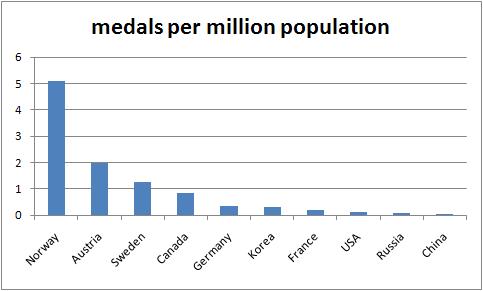
Norway has a population of about 4.5 million (2009 levels), or less than 14% of Canada's. And yet it manages to win 23 medals compared to Canada's 26. Doesn't that count for something? China has a huge population, so that competition for the Olympic team is likely to be very strong. The US has a high per capita GDP. These smaller countries of Europe, however, with small populations, do very well. I tried the same graphs with just gold medals or with GDP rather than population, and you get approximately the same results. Also note I just looked at the top ten countries in the medals table. If you go down further you may find a small country that won one or two medals and would finish on this list.
BTW, that gold medal record the Canadians broke? It was shared between Russia and ... Norway. Matthew Futterman shows that even using historical models, Norway did very well this year.
(And if this post does not get a link from noted NARN Norgephile Mitch Berg, he has seen his last cigar.)
UPDATE: Prof. David Wall of the Geography Dept. here at SCSU sends along this graphic too:
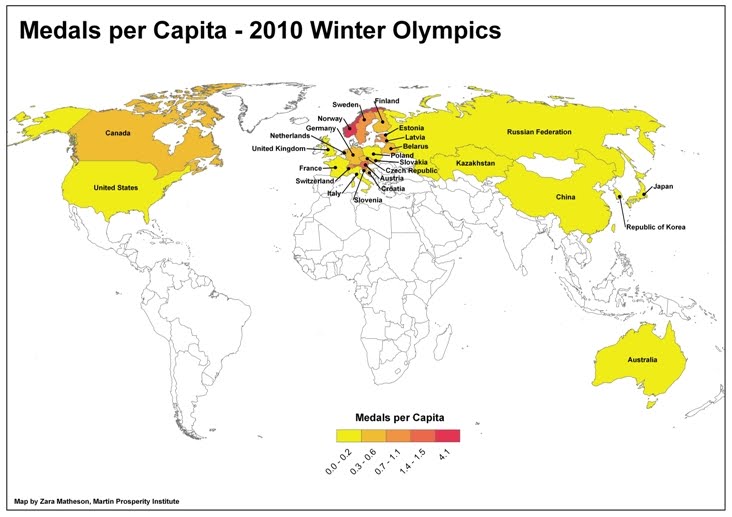
A map of medals since the beginning of the Winter Olympics is similar.
Friday, February 26, 2010
How out of touch are you old fogies?
Rowdy curling crowds; spontaneous street parties; public drunkeness. You don't have to look far for evidence that the crowds at Winter Games in Vancouver know how to have a good time.
And, as if anymore proof is needed that a wild Olympic atmosphere permeates B.C.'s largest city, now there's an apparent condom shortage.
That's right. As you read this, an emergency shipment of condoms is desperately making its way across Canada to the West Coast city.
Health officials in Vancouver have already provided 100,000 free condoms to the roughly 7,000 ahtletes and officials at the Games. That's about 14 condoms per person. But as of Wednesday, those supplies started running dangerously low.
So naturally, the Canadian Foundation for AIDS research decided to step and make sure there were no hitches in Olympic action.
"When we heard about the condom shortage in Vancouver, we felt it important to respond immediately," said Kerry Whiteside, CANFAR's Executive Director. The organization assembled three large boxes of about 8,500 condoms, much to the relief of libidos at the Olympic Village. They're expected to arrive on Thursday.
Labels: sports
Thursday, February 11, 2010
Rose bowls at the margin
...there are two costs that seem especially relevant: (1) The costs of getting big donations are more than just seats on a plane to the Rose Bowl. Tremendous amounts of time, energy, and resources go into "asks," and these costs should be factored into the whole calculation about whether a firm/university is "making it." (2) Universities like UW-Madison receive a tremendous amount of support from taxpayers. Thanks to taxpayer subsidies, prices for tuition are kept artificially low. Furthermore, many student scholarships are funded by tax dollars. (Here, in Georgia, for example, lottery revenues cover tuition costs for all students with a B or better average in high school.) Again, these are just two of the relevant costs that must now be considered once we take the "look at the overall picture" approach.This is no doubt true, but one would want to think then about the rate of substitution between the salary of another fundraiser in the alumni office and the recruiting costs of a star quarterback. Given that the athlete is barred from receiving a wage, it may be that the relative prices of athletes and fundraisers tilts towards a better athletic program and fewer glad-handers.
There are also questions to be raised about whether your basketball team getting to the Final Four of the big dance gets you more applications for admissions, from people with parents with deep pockets perhaps. It's advertising for your school, which is much cheaper in basketball than football due to team size (and why so many schools want D-I basketball programs.) Prof. Beaulier is right, you can add more costs on if you want ... and more revenues. This is why economists like that ceteris paribus assumption.
So maybe we take Prof. Beaulier's Austrian advice and say "we just don't know," which is true if you insist on moral certitude as your standard of knowing. Or we could think marginally, arguing that for the last person you put on the plane to the Rose Bowl, the price of the ticket was lowered to induce an additional contribution to the alumni fund, given the fixed costs of the alumni office's payroll. I wouldn't call that a moral certitude, but I can predict a great deal of human behavior thinking marginally.
Monday, February 08, 2010
You really think they lost money?
This is a nice time to remind my SCSU readers that I am teaching economics of sports again this summer, my swan song from the chairmanship (they pay me to teach one summer class while dealing with the administrative detritus of the previous academic year.) Here's the syllabus from last time, which I need to refresh soon. Maybe Phil Miller will refresh his sidebar and I can steal his stuff.
Tuesday, January 26, 2010
The resource curse, there and here
Our finding that oil windfalls translate into little improvement in the provision of public goods or the population�s living standards raises a key question � where are the oil revenues going? As a way of addressing this question, we put together a few pieces of tentative evidence:
- First, oil revenues increase the size of municipal workers� houses (but not the size of other residents� houses).
- Second, Brazil�s news agency is more likely to carry news items mentioning corruption and the mayor in municipalities with very high levels of oil output (on an absolute, though not per capita, basis).
- Third, federal police operations are more likely to occur in municipalities with very high levels of oil output (again in absolute terms).
- And finally, we document anecdotal evidence of scandals involving mayors in several of the largest oil-producing municipalities, some of which involve large sums of money.
 More locally, consider a place that has a large power plant, say, Becker or Monticello.) Those plants generate a good deal of revenue to the municipality and in good times the property tax revenues permit cities to add lots of services, and hold down property taxes for residents. But they also become very dependent on that money and when times get bad it creates a lot of stress. (The city administrator in Becker blogs and here's what he's written about taxes from the coal plant there, called Sherco.)
But the taxes are the result of intense lobbying between the power or oil companies and the state. The state forces different property tax rules on the localities here in Minnesota and then the cities have to lobby back (from the rest of us) to get the money taken away (to make energy firms richer.) This story replays not just in Minnesota but in resource-rich states like Alaska, where dependence on oil firms colors the politics that gave us Ted Stevens and Sarah Palin.
I'm very happy to join my friends in talking about nuclear power, but explain to me why that conversation between state and corporation should produce a deal any better for the taxpayer than having the government talk to Zygi Wilf?
What is needed, as always, is competition. The resource curse happens in a world where the resources are monopolized by the government (I struggle to think of a place where this isn't so. Can anyone name one for me?)
Labels: economics, Energy, Minnesota, rentseeking, sports
Monday, January 18, 2010
About that Vikings stadium article
Your child is threatening to leave if you don't let him go out with his friends tonight. Your decision whether to cave in to this kid or not depends in part on whether you think he'll carry out his threat. If you think the threat is real, you may be more willing to relent. (Of course not me. I'm a hard dad.)
Likewise, we've been through this with the Twins. They at one time told us they were leaving, taking their marbles and going to Charlotte. While some fans panicked, many others and the state of Minnesota called Carl Pohlad's bluff, which ended up failing. It took another 8 years before the papers got signed for a new Twins stadium. Interestingly, at that time there was no threat of leaving.
This matters greatly to the reaction of people to a survey asking "how much would you be willing to pay to build a new stadium for the Vikings?" When such a survey was done for the Jacksonville Jaguars, they got a very low number (about $36 million, well below what Jacksonville subsidizes for the Jags.) The authors of the Viking study point out that at the time the Jag survey was done the threat of Jacksonville leaving had disappeared. So you had to ask Viking fans at the time of a threat. The use of 2002 in that Viking study is not an accident. It's the time Red McCoombs was threatening to sell the team to an out-of-state party because his in-state offers were too low.
The answer that the paper gives of $515 per household overstates the case the authors made, since building the new stadium costs them a perceived amount of future income as well. The authors measure this as well, and the net-of-stadium benefit to Minnesotans is $292. They might be willing to pay this if you have a credible threat of leaving ... which is why sports leagues go to such lengths and torture fans. It's a pretty ugly thing to do to people, but when the payoff is that large, it's hard to pass up that temptation.
There are many people skeptical of this paper's methodology, but it continues to be used in cost-benefit analysis to measure the benefits of public goods, and if anything I think the authors over-sampled non-metro population to be sure they were a little conservative on their value. If you compare that number to today -- when while Viking fans are giddy, they do not think the Vikings will leave next year -- you will find it an obvious exaggeration. That's not what the paper measured though. It is more the answer to the question "how much would each Cleveland resident have paid if they saw Modell closing the door on the van?" Doesn't sound as far-fetched then, does it?
Monday, December 28, 2009
The jawbone of an ass
While the Jets win today ended Indianapolis� streak and showed once again how difficult it is to go undefeated, I want to congratulate the Colts on a great run.Don Shula. Remind me how many teams with winning seasons were on the Dolphins' regular season schedule again? (Make a peace sign, you got it. Two 8-6 teams, that's it.)
Labels: sports
Wednesday, December 23, 2009
In my mailbox
Money is college sports is nothing new. But readers will be amazed at the alarming depth and breadth of influence, both financial and otherwise, that college sports has within our culture. Readers will learn how academic institutions capitalize on the success of their athletic programs, and what role sports-based revenues play across campus, from the training room to the science lab. Yost pays particular attention to the climate that big-money athletics has created over the past decade, as both the NCAA's March Madness and the Bowl Championship Series have become multi-billion dollar businesses. This analysis goes well beyond campus, showing how the corrupting influences that drive college athletics today have affected every aspect of youth sports, and have seeped into our communities in ways that we would not otherwise suspect. This book is not only for the players, policymakers, and other insiders who are affected by the changing economics of college athletics; it is a must-read for any sports fan who engages with the NCAA and deserves to see the business behind the game.
Monday, December 07, 2009
Guess who said it
"The notion that because some people abuse something, you prevent everyone from doing it is as great of a threat to the individual as any cause I have ever seen."From Chad Millman's ESPN Insider blog (subscriber link.)
HINT: It has to do with internet gambling. Click here when you think you know the answer if you can't use Chad's blog (which is, by the way, the best place to read about sportsbooks anywhere in the world.) Rich Muny at Big Government describes this as Prohibition Redux.
Note which party is on which side here, and shake your head. Freedom is still looking for an agent.
David Henderson offers another ray of hope.
Tuesday, December 01, 2009
After watching last night's football game...
If anyone wants to argue that the Patriots played poorly last night because Belichick had damaged their psyches a few weeks ago, please, stop reading this blog.
That is all.
Labels: sports
Monday, November 16, 2009
You can always call him stupid ex post
I disagreed by instinct. As I told a student after I got to campus who asked about the decision, I said you had to put your head in Belichick's place without regard to what eventually happened. You have to argue ex ante rather than ex post.
Your team has given up two fourth quarter touchdowns in possessions of 2:04 and 3:32. You are playing against arguably the greatest QB ever (arguably, acknowledging that the greatest QB ever could be your own QB.) You are on the road. You have a play that has worked quite well, and you ran it successfully earlier in the game. (Game log) And it's not the first time Belichick had done it this season, Michael Lombardi reminds us. He went 4th-and-1 from his 24 up 19-10 in the third quarter against Atlanta (successful, game log.) So this isn't gut instinct: Belichick has thought the math through.
I was going to write out the math of this in terms of expected values, but Brian Burke has already done this.
With 2:00 left and the Colts with only one timeout, a successful conversion wins the game for all practical purposes. A 4th and 2 conversion would be successful 60% of the time. Historically, in a situation with 2:00 left and needing a TD to either win or tie, teams get the TD 53% of the time from that field position. The total WP (win probability -- the likelihood you would win the game) for the 4th down conversion attempt would therefore be:Not to say that Belichick had those numbers firmly in his head and thought of it in terms of WP, but he's shown evidence that he's willing to go for fourth downs in his own territory, that the gain in punting would have been to reduce the likelihood of the average NFL team to score the winning TD to 30% from 53%. He certainly knew he would be skewered if his team failed to convert ... which he had to think was a 40% probability. He was confident enough to accept that fate in return for giving his team its best shot at winning the game. In terms of the rest of the season, would you rather have your team lose and the blame placed on your coach for a "bonehead move", or lose and have your defense questioned for its inability to hold a lead?
(0.60 * 1) + (0.40 * (1-0.53)) = 0.79 WP
A punt from the 28 typically nets 38 yards, starting the Colts at their own 34. Teams historically get the TD 30% of the time in that situation. So the punt gives the Pats about a 0.70 WP.
Statistically, the better decision would be to go for it, and by a good amount. However, these numbers are baselines for the league as a whole. You'd have to expect the Colts had a better than a 30% chance of scoring from their 34, and an accordingly higher chance to score from the Pats' 28. But any adjustment in their likelihood of scoring from either field position increases the advantage of going for it.
Labels: sports
Monday, October 12, 2009
NFL = Not for Limbaugh?
NFL Players executive director DeMaurice Smith on Saturday made a move to solidify the union against a bid by conservative talk show radio host Rush Limbaugh as part of a group that aims to purchase the St. Louis Rams.So what on earth are they talking about? ESPN comes up with a list of 'examples'. To wit,
In an e-mail to the union's executive committee on Saturday specifically addressing Limbaugh's bid, Smith said, "I've spoken to the Commissioner [Roger Goodell] and I understand that this ownership consideration is in the early stages. But sport in America is at its best when it unifies, gives all of us reason to cheer, and when it transcends. Our sport does exactly that when it overcomes division and rejects discrimination and hatred."
Limbaugh has expressed a number of controversial racial ideas in the past. For example, he suggested that Gen. Colin Powell supported Barack Obama's presidential candidacy simply because he was black, and he also stated that the media wants black quarterbacks to do well and that Donovan McNabb doesn't deserve much of the credit he has received for the Eagles' success.I don't see how it is hateful to suggest that a black man is rooting for another black man to become president. Yes, I know Powell said that wasn't the reason, but as Limbaugh replied, please name the white liberals Powell has endorsed.
Labels: sports
Tuesday, September 08, 2009
I'm no more a playa than Plax
Monday, August 17, 2009
Path dependence, Dominican edition
I have no idea why Adrian Beltre chose not to wear a cup, but it might have a lot to do with something I just learned, speaking with someone who has been very involved in Latin American scouting. Players in the Dominican and Venezuela tend not to wear cups while playing, largely because they can�t afford them as youth.
A cup costs about six bucks. If you go for the Nutty Buddy, the highest-tech in cojone protection, you�re talking about twenty bucks. Let�s split the difference and say ten bucks each.
Besides the obvious enjoyment of having athletic supporters with rhyming names, I think it's interesting that when one learns a skill a certain way, you have to keep doing it that way even if the peculiarity has nothing to do with how you perform that skill. Sure, the damn things are uncomfortable at first, but the adjustment period isn't that long, and you could learn it during spring training.
If I invest millions in a player, don't I as an owner have the right to make him wear the protective gear that allows him to stay on the field?Monday, July 27, 2009
Hall and Rose
I think Buster Olney has it about right (link for Insider subscribers):
When I first saw the story, I was surprised to feel this: total ambivalence.And the rules for HOF voting are quite clear -- it would be the Veterans Committee who would vote on him, as he's been out of baseball more than 20 years (last played in 1986.) At the bottom of this press release (when Joe Gordon was elected by the VC) is a list of all the players who are on that committee. The Committee includes several former teammates of Rose: Bench, Carlton, Morgan, Perez, Schmidt, to name five. Hank Aaron says Rose belongs in the Hall. So it's not inconceivable that he could be put in.Rose was an extraordinary player whose passion for success is reflected in his remarkable records: ... He was a great player who holds a unique place in the game's history. This is inarguable.
And so is this: During the past two decades, his behavior has been appalling. He has been nothing less than a lowlife. ...
If he's reinstated, that really doesn't ensure that the Veterans Committee would vote him into the Hall Fame. Undoubtedly, some members of that committee will argue that Rose always has considered himself to be above the rules, and given that, some won't want him in the club.
But quite frankly, Rose's legacy won't be affected one way or another by his inclusion into the Hall of Fame.
If he's honored at Cooperstown, he'll always be a dishonored former star. And he'll sell the moment.
As I remind people during our presentations on HOF voting, the Hall of Fame is a museum with an educational mission. It is ultimately up to its board of directors (which, by the way, includes Joe Morgan) to decide not only if Rose should be enshrined but how. It would be consistent with an educational mission to admit Rose but provide a full context of his career, including his journey into ignominy. Olney's ambivalence could be captured in a good museum display, and people could consider why baseball has rules on betting. It could create a display on the Black Sox perhaps next to Rose's.
I rather hope it does. It would be good practice for the coming storm over Barry Bonds.
Agree or disagree? You could comment to me, or you could write to the Veterans Committee yourself here, or by regular mail to Hall of Fame Veterans Committee, 25 Main Street, Cooperstown, NY 13326.
Sunday, June 21, 2009
Safety versus Risk Taking
How true! We have had it so good for so long that we are letting the risk averse mindset control much of what we do and teach our kids. We deny them basic activities at school so no one gets hurt. We often do their chores. We teach them that things will always be good, come out their way or that someone else is really at fault.
What we're really teaching them is to avoid life. As I've told my students, "Life is not risk free so get over it." You have to push yourself; try something outside your comfort zone. When you push yourself, you will discover that you can do more than you thought you could do.
Avoiding risk is not safe, anyway. We take risks every day: driving a car, walking down the street, etc. Risks simply must be faced: the risk of failure, humiliation, hurt. We cannot protect our children from the world so we need to teach them how and when to be rational risk-takers.
I remember a cartoon from my youth. The strip, Nancy, had a character Sluggo who woke up on Friday the 13th, and decided to stay in bed, just to play it safe. What happened? The ceiling fell on him!
We owe it to our children, our students, and ourselves, to take risks. Evaluate the odds, put a plan in place, then just do it. We will learn if we fail but will experience previously unknown joy if we succeed.
Friday, June 12, 2009
Why I have a man-crush on Bill Simmons
The thing that everyone forgets about this season is that because of the economy, nobody improved their team at the trading deadline. Cleveland, Boston, L.A., San Antonio, Denver, Houston, Dallas�all of them had holes and all of them were terrified of fixing them because they didn�t want to take on any money. Only Orlando swung a deal that had them adding money (Rafer Alston); they didn�t have a choice because they lost their point guard. The biggest loser was Cleveland: They could have added Shaq, Antwan Jamison, Vince Carter, Richard Jefferson, even Zack Randolph; instead, they basically said, �No thanks, we�re good.� And they weren�t. So we had a flawed playoffs to some degree, and even the Finals feels flawed. Ideally, the Lakers would have added one more quality shooter and Cleveland would have gotten LeBron more help (so we wouldn�t have even seen Orlando). Didn�t happen. That�s why I wrote a column calling the N.B.A. �The No Benjamins Association� last February. Just wait until this summer; you will see guys worth $60 million in the old market settling for short-term, $20 million deals. Every flag at every Ferrari dealership will be hanging at half-mast.He's been saying this for quite a while. I wonder how the Minnesota Twins feel about having their new stadium open next season? Think the Pohlads stuck that extra $50 million into the field for nothing? �(And did you know that the Twins are selling their outfield bleacher seats based on the price of the Dow? �No, me neither.)
Monday, May 04, 2009
Eurobabies
One guy has figured out a way not to pay the freight for some university. Meet Jeremy Tyler, a high school junior who is a very gifted 6'11" hoops star:
Tyler... announced that he was going to not only forgo college, but also to skip his senior year of high school, to turn pro. And I'm not talking about the NBA. Tyler is heading to Europe to play professional basketball and is expected to earn a six figure starting salary. His plan is to gain professional experience until he is eligible for the NBA draft in 2011.If you'd like to see Tyler's talent, he has (like most HS stars) a video of his prowess on YouTube. I'd call that "dominating". He's got feelers from teams in Spain, Italy and Israel. And he and his family have thought this through.
On a cost-benefit-analysis, Tyler is making a great decision. He is giving up zero income for his senior year of high school, and missing out on a measly scholarship package (worth approximately $50,000) from the college of his choice, which he certainly doesn't intend to graduate. During those two years, Tyler will earn at least $150,000 more (probably closer to a quarter million) than he would have if he played another year of high school and a year in college -- due to the NBA's rule that you have must sit out one year post-high school. Not to mention the fact that he stands a good chance to improve his pro stock by playing against better talent in international pro ball, as opposed to dominating high school kids, as well as potential paydays from endorsement deals.
It's not without risk. The risk of injury is everywhere (and I can't tell you if the medical care Tyler would get in Europe if he was injured would be better or worse than in the States), so the relative risk here is that he cannot hide his shortcomings by playing against weaker competition, since the European professional leagues are largely better.He and his father are bracing for an establishment backlash that fails to appreciate their motivation, determination and appreciation of the intrinsic value of education. They think most of it will be designed to protect the billion-dollar business of amateur basketball.
�It�s just the old way of doing things and no one wants to swallow the pill of change,� [father] James Tyler said. �Basketball is an American sport and they want the kids to go through the channels. And I think there is so much money generated in collegiate sports that they don�t want that interrupted.
�It�s a double standard.�
Keep your eyes out for Brandon Jennings in next month's NBA draft -- he too went to Europe. But at least he played his senior year of high school in the States. If Tyler is successful, Jennings may regret that lost year of income.
Monday, April 13, 2009
Baseball deflation
Tickets for the all-you-can-eat pavilion in right field are being reduced from $35 to $25 for 70 of the team�s 81 home games. The price includes unlimited hot dogs, nachos and soda.It's not because the team stinks. It's the economy there: The Angels had a hard time selling out their Opening Day and were offering 4-for-3 discounts, even though officially the game was "sold out".
Prices for soft drinks will be $3.75, down from $5; bottled water will be $3.75, down from $5.75; and beer will cost $6, down from $8, at concession stands.
...A free fan club for kids will be offered, and fans arriving by car will receive a free team publication. Also new are all-inclusive packages that include tickets, T-shirts, peanuts and parking starting at $99 for a family of three.
Fields are getting smaller, and the need is therefore to sell out. Teams are building stadia with more variation of ticket experiences (here's one unhappy Yankee fan's view of the new stadium; pay particular attention to the two pictures of upper decks of old and new Yankee stadia) to push fans into higher-priced seating. But if you are selling scarcity value of seats to boost ticket prices, a recession like this one making 4-for-3s and price-cutting (at an older, larger Dodger Stadium) is going to have a larger impact on team revenues than if you were still trying to fill the larger caverns of the old Shea-sized stadia.
Thursday, March 19, 2009
Public and private responses of culture to recession
As Rick Reilly points out, it does mean you have to watch the Timberwolves.
But at least the T'wolves understand a demand curve: If the demand for your product falls because, say, your best player blew out his knee, or the firing of Matt Millen leaves your GM the worst in professional sports, it's possible the profit-maximizing price for your product fell as well. They might not know Lebron from Love, but seems Wolves management understands dollars.
Not so the city of Chicago, who can't seem to figure out that recessions might be good for museums (h/t: WSJ BotW):
The city is mostly interested in negotiating for free dates from the museum. But the museum has already given away all its admission revenue from February after experiencing increased attendance last year. The Institute had or has a free admission day once a week. Like the T'Wolves, the Art Institute makes available high-priced tickets for those willing to pay, and has historically maintained free days (no doubt in part to its attractiveness to would-be contributors or funds and art exhibits.)Chicago would cut off the free water spigot and other public subsidies to museums that charge more than $10 for admission, under a measure proposed Wednesday in response to the Art Institute's 50 percent hike in its admission fee.
The increase approved last week by the Chicago Park District board would raise the Art Institute's admission fee from $12 a person to $18, a "remarkable jump," according to Ald. Edward M. Burke (14th), chairman of the City Council's Finance Committee.
Less than three years ago, the Art Institute was still one of the few big city museums with no mandatory admission fee. Museum patrons were asked to pay a "suggested" fee. But those who refused were not turned away.
"A family of four going to the museum would have to pay $72, plus parking, plus a Coke or a candy bar. It's becoming impossible for Chicago citizens to take advantage of these cultural institutions," Burke said.
Noting that the Art Institute received a $6.6 million Park District subsidy last year, Burke said, "I know their endowment has probably suffered with the downturn in the economy. But that's no excuse to stick it to the hard-working men and women of Chicago who are already paying taxes that subsidize these institutions who might like to take their kids to see these great treasures."
Those who do not have the money have options of other cultural activities which are free (such as the museum at Northwestern, or the Chicago Cultural Center.) Nobody makes someone go to the Art Institute, but someone makes it pay for water and maintains a monopoly on its provision. It is all pandering, of the same kind as is occurring with AIG, proven by the last line of the Alderman's outrage:
"It's one thing to charge $18 for somebody who's coming here from New Orleans or New York or San Francisco. It's something entirely different . . . to charge $18 to a taxpayer who lives in Chicago, who�s already paying taxes that subsidize these institutions.�And it's entirely another thing, Alderman, to coerce money from Chicagoans to give to a museum when they may lose their job -- they won't get their property taxes back -- all so that you can grandstand to the media about providing access to art.
Wednesday, December 17, 2008
To prove we don't know anything about this either
Labels: Final Word, humor, sports
Drug theater of the absurd
Grandmaster Vassily Ivanchuk refused to submit a urine sample for a drug test at the Chess Olympiad in Dresden and is now considered guilty of doping. The world of chess is outraged that he could face a two-year ban.Chess. CHESS. Unfreakingbelievable. This caught my eye because 1) I used to play a lot of chess (and still teach kids when I find the time) and 2) after writing this, I was curious if the drug of choice was Red Bull. Am I to look out for my kids who drink more Dew than my radio board ops?
It makes sense that anabolic steroids, the bulk-producing drug of choice for weightlifters, and EPO, the wonder drug of the cycling world, would not improve a chess player's performance. But when a chess player nears the end of a match and comes under mounting pressure, he can hyperventilate, and his pulse can shoot up to 160 and his arterial blood pressure to 200. In that situation, beta-blockers could help a player keep his head clear.Breathing exercises and a paper bag would help that too. I am a bit incredulous that it's beta-blockers they are looking for. Sure enough, you can't time the dosage of a beta-blocker to help when you need the help in a chess match. There's too much variability in length of time. So,
It would certainly make sense for a chess player to take Ritalin or Modafinil. Both substances increase the ability to concentrate. Students take the drugs during exams, and doping inspectors test chess players for both substances.So I was right? FIDE, the organization that oversees chess championships, is trying to keep the sport clean of drugs that help you focus? I am still trying to figure out why. Wait, next paragraph:
The only reason there are doping tests in chess in the first place is that the World Chess Federation (FIDE) has been trying, since the late 1990s, to make chess an Olympic discipline. And anyone wishing to be part of the Olympics must submit to the rules of the International Olympic Committee (IOC).I don't know what strikes me as more absurd: �chess in the Olympics? �or the IOC testing chess players for Ritalin? �Powerboating is in the IOC's list of recognized sports (though not in the Games themselves, yet). �NASCAR apparently lets their drivers advertise those energy drinks (I'm pretty sure I saw Rusty Wallace in an ad.) �What are they testing powerboaters for? �
h/t: Kouba.
Labels: sports
Monday, December 08, 2008
Hey kid, put down that Red Bull
The full article is here, and its key recommendation appears to be "that mentally competent adults should be able to engage in cognitive enhancement using drugs." Having watched body-building competitions and with experience in sports economics, my game-theoretic brain thinks we would shortly see most students trying to obtain these drugs -- which are still only available by prescription, so many may not find doctors who will prescribe the pills -- particularly at highly selective, competitive institutions. The more highly competitive the field, the more likely you would see them."We should welcome new methods of improving our brain function," and doing it with pills is no more morally objectionable than eating right or getting a good night's sleep, these experts wrote in an opinion piece published online Sunday by the journal Nature.
The commentary calls for more research and a variety of steps for managing the risks.
As more effective brain-boosting pills are developed, demand for them is likely to grow among middle-aged people who want youthful memory powers and multitasking workers who need to keep track of multiple demands, said one commentary author, brain scientist Martha Farah of the University of Pennsylvania.
"Almost everybody is going to want to use it," Farah said.
So what would higher education institutions do about this? Would they randomly test students for Ritalin, Adderall, or Provigil? They don't test for Mountain Dew and 5-Hour Energy. They don't test for Red Bull or other caffeinated drinks. Should they?
And if "mentally competent adults" can choose "cognitive enhancement using drugs", why cannot mentally competent athletes choose what to put in their bodies? I'm pretty sure the steroid story is something like the game theory story of the hockey helmets. Does that work for you as well with Ritalin?
Labels: economics, higher education, sports
Wednesday, December 03, 2008
Sue to play
Vikings defensive tackles Pat and Kevin Williams were granted a temporary restraining order Wednesday evening in Hennepin County District Court that allows them to return to the team and potentially play Sunday at Detroit. However, Judge Gary Larson said a more extensive hearing on the players' status could occur as early as Thursday if the NFL desires.
Their status for Sunday's game at Detroit remains uncertain, depending on the NFL's next move.
On Tuesday, the NFL suspended the Williamses for the final four games of the regular season without pay for violating the league's policy on anabolic steroids and related substances.
Really? This is what judges do, interfere in a league enforcing its eligibility rules for players? Yes. They did it with Maurice Clarett. Where's the line? Odell Thurman is out of the league because it's believed he suffers from alcoholism. He can't apply to get back in the league this season. Had he gotten treatment, could he sue?
If the Lions are winning a game this year, I think this is it.
Labels: sports
Monday, November 24, 2008
So what happens to naming rights?
- Ameriquest Capital (Texas Rangers, $2.5 million a year through 2034)
- Bank of America (Carolina Panthers, NFL, $7 million a year through 2024)
- Bank One Ballpark (Arizona Diamondbancks, MLB, $2.2 million through 2028)
- Citizens Bank Park (Philadelphia Phillies, MLB, $2.3 million, 2028)
- Comerica (Detroit Tigers, MLB, $2.2 million, 2030)
- Conseco Fieldhouse (Indiana Pacers, NBA, $2 million, 2019)
- Edward Jones Dome (St. Louis Rams, NFL, $2.65 million, 2013)
- Wachovia Center (Phila. Flyers/Sixers, NHL/NBA, $1.4 million, 2023)
- Fleetcenter (Boston Celtics/Bruins NBA/NHL, $2 million, 2010)
- Great American Ballpark (Cincinnati Reds, $2.5 million, 2033)
- HSBC Arena (Buffalo Sabres, NHL, $800k, 2026)
- Invesco Field (Denver Broncos, NFL, $6 million, 2021)
- KeyArena (now vacant in Seattle, $1 million, 2010)
- Lincoln Financial Field (Phila. Eagles, NFL, $6.7 million, 2022)
- M&T Bank Stadium (Baltimore Ravens, NFL, $5 million, 2018)
- Mellon Arena (Pitssburgh Penguins, NHL, $1.8 million, 2009)
- Nationwide Arena (Columbus BlueJackets, NHL, unknown)
- PNC Park (Pitts. Pirates, $2 million, 2020)
- Raymond James Stadium (Tampa Bay Buccaneers, NFL, $3.1 million, 2026)
- RBC Center (Carolina Hurricanes, NHL, $4 million, 2022)
- TD Waterhouse Centre (Orlando Magic, NBA, $1.6 million, 2003)
Wednesday, November 19, 2008
Magic and pensions
How do we evaluate the annual cost of Magic Johnson? Did he earn $1 million a year for 25 years, as he was paid, or did he earn $2.5 million a year ($25 million divided by ten years of playing, including the coaching year and two years in which he tried to come back?) Or $3.54 million a year for the seven years he did play? How do you factor in the time cost of money, etc.?
I bring this up in the context of Felix Salmon's post on the use of $70 or $73 per hour as a number to represent the cost of an hour of labor in producing an American automobile:
So where do you count the pension obligations, if not there? If a sports player is injured, or retires, and has a guaranteed contract, that player's salary is considered part of the team's payroll. (There were reasons for relating to the salary cap in the NBA for the Lakers to have structured Magic's contract that way, but it isn't material to this discussion.) We could, I suppose, impute those pension costs back to the wages of those past workers. It makes sense in a way, since those pension costs are sunk -- the marginal cost of GM hiring another hour or labor isn't changed by the size of their past pension obligations.It's not true.
The average GM assembly-line worker makes about $28 per hour in wages, and I can assure you that GM is not paying $42 an hour in health insurance and pension plan contributions. Rather, the $70 per hour figure (or $73 an hour, or whatever) is a ridiculous number obtained by adding up GM's total labor, health, and pension costs, and then dividing by the total number of hours worked. In other words, it includes all the healthcare and retirement costs of retired workers.
But is changed by any additional obligations they take on. UAW-represented workers still get defined-benefit plans, so those costs do get added on even though they don't appear in current payroll figures. They are akin to the last ten years or so of Magic's contract. If you are going to subtract out the pensions of retired workers, you have to add back in the expected present value of the pensions to be paid to your current workforce. It might not be $70 or $73, but it's likely to be pretty high.
Thursday, November 13, 2008
A sad day
Wednesday, October 22, 2008
Win it for Kent
Readers will know my love of the Red Sox. �It was the most bizarre weekend for me, watching them lose to the Rays. �A loss in Game 7 of an ALCS five years ago -- back when Dan Shaughnessy was still selling copies of The Curse of the Bambino --�would have devastated me for a week. �I would not watch the World Series. �I would not talk baseball. �People who see me would talk about anything else and then get away from me as soon as politely possible. �This year, not the same. �Remember, until Sunday night my three favorite teams in the world -- Red Sox, NY Giants, and Celtics -- were simultaneously world champions of their sports. �If I complained at all about the weekend series, would you not want to hit me in the head? �So would I.
About twenty months ago a good friend and colleague here passed away, known often in the earlier days of this blog as "my liberal lunch friend." �Sports was one of the things that united us. �Kent and I had gone together to Philadelphia to see our two teams play each other in the Phillies' last year in Veterans' Stadium. �It was my first trip to Philly; Kent had been a fan since childhood, though he was raised in the Rochester, NY area. �He had basically "sat with the family" after I suffered the Aaron Boone Sudden Death funeral. �We had always said that, if our teams ever got in the World Series we'd root for the other guy's team. �"What if we're in it against each other?" �That would be cool, we decided, but we couldn't talk to each other but maybe ten minutes the day after each game. �I'm sure we would have been friends after that, but it would have been weird. �Last fall, when the Red Sox had won their second championship in four years, there was some sadness over missing lunch with my baseball friend. �The discussions last winter would have been full of Sox and Phillies, teams we both thought were being run the right way. �We each tracked the other team's substitutes, farm systems, free agent moves. �(Same was true of football -- he rooted for the Redskins. �Unfortunately, we never got Kent into the NBA because he likes college basketball too much. �He went to D-I schools; I went D-3.)
So when Sunday night started I wondered: �If the Red Sox win, they play the Phillies. �How do I feel about that? �I would have rooted for the Sox, of course, but it would have been weird. �Fridays was our day to have lunchs, and I still don't have lunch in our place there. �Would I have gone back there like some bad movie, having an imaginary discussion? �I don't know.
I do know what I'll be doing in a couple hours, though. �I've got a Phillies hat and no dilemma. �No offense, Tampa, but I'm rooting for the NL for the first time ever.
In 2004 as the Sox came back from 0-3 against the Yankees, on a fan bulletin board there was a long thread called "win it for..." �For me it was a cousin who was shut in, mentally challenged -- "oh, he had a bad drug experience, what a waste" -- but who one day turned me on to some mimeoed home-published book of weird baseball stats that he bought with his meager income each winter. �My cousin seemed to most people a lost soul, but through him I got back into baseball and learned about some guy in Kansas named Bill James. �From him came Roto and a life of baseball as something more than just the fate of the Sox, but who also reminded me it always came back to your team, your player, your hero. �He died in the early 2000s. �So in 2004, "win it for Gary." �And they did.
Sharing that love with someone is important, and for about ten years that guy was Kent. �Yes, Tampa is miraculous and a great story, but they've only been a team for ten years. �A team from a city that has won nothing in 28 years is fit to carry a baseball wish: �Win it for Kent.
Monday, September 15, 2008
Right on Target
Some speculate the value of the naming rights at $4-6 million; given that Target would also get the pedestrian mall between the park and downtown as "Target Plaza", I am going to bet on the high side of that figure.The club announced on Monday morning that they have reached an agreement in principle on a 25-year deal that includes the naming rights for Target Field. The ballpark is scheduled to open in 2010.
Financial terms of the pact were not released.
Compared to the disaster going on with the football stadium naming rights in New York City, we should be relieved to have this done quietly. It interests me though that Target would decide the experience with the Wolves and Target Center have been good enough to double its bet on naming sports stadia. The evidence out there suggests naming rights are profitable to the teams that sell them (though it doesn't appear to encourage spending more on players) but show no effect on the profits of the firms that buy them. (Enron Field, anyone?) Did Target value it higher because it didn't want another park named after some other firm so close to the arena it had already named?
Don't leave it to the coin
But of course Denver only got this chance after a blown call by the referee, who had told both coaches at the time he had blown his whistle to stop a play he shouldn't have stopped, but that he couldn't "unblow the whistle", as it were. Listen to Coach Turner of San Diego and this from ESPN:
Now, my friend observed that perhaps this is what Denver coach Mike Shanahan thought as well. Rather than decide the game on the coin flip, it should be decided on one play, on the field. Denver's offense versus San Diego's defense, for the game. (There would have been nearly no time left for the Broncos to get another opportunity to score.) He thought it wasn't courage that motivated Shanahan, it was honor.
For those who wonder why Steve Bartman still can't go to Chicago, that's an angle you should support.
Labels: sports
Monday, July 21, 2008
My opponent gave you stuff
Michael reports this morning that the Franken campaign has gone so far as to release an ad deriding Coleman's support of building the Xcel Energy Center.
I find the Franken campaign's choice odd. The reason these stadia keep getting public dollars is because the public believes somehow -- mistakenly, in the view of economists, but this is hardly the first time the public has chosen to ignore the economists -- that they are of benefit to a city and would be underprovided by private financing alone. Pointing out that Norm took from Peter to give to Paul is hardly a way to gain Paul's support in voting against Norm. There may be, there might be, a few Peters who are persuaded by the ad, but if that were true these stadium deals would not keep gaining passage. And support for hockey is enough in this state that even outstate arenas like St. Cloud and Bemidji draw public funding.
I wish there was a spokesman for the economists' view of public financing of sports stadia, but I don't think Al Franken is the right guy for that job either.
Labels: Coleman, Franken, Minnesota, sports
Wednesday, July 09, 2008
A Real Female Star
Then there are the athletes. Many are glory hounds after fame, prestige and money but there are others who truly love their sport and through their talent live life to its fullest. One such athlete was Agata Mroz, a world class volleyball player from Poland, profiled in this link from National Review. She stood over six foot and had the ability to block like very few. She led the Polish national volleyball team to European championships in 2003 and 2005 and continued in international competition for a few more years.
Unfortunately in 1999, when she was 17, she developed MDS, a collection of disorders that prevent the bone marrow from producing enough blood cells. Her MDS progressed to leukemia over the years but she always kept her zest for life.
In June of 2007, she married and despite the risk, decided to try to get pregnant. Why? She said in a February news interview, �I felt happy that I would know what it is to be a mother and that I would give my husband something good of myself.�
Her daughter was born prematurely but is now healthy. In the meantime, Agata's condition worsened. She delayed a needed bone marrow transplant because she feared it might impact her then unborn child. Seven weeks after the birth of her daughter, Lilliana, Agata underwent bone marrow transplant surgery, she didn't make it. At her funeral Mass, the bishop paid high tribute to Agata when he said her life was a witness of �love of life, motherhood, the desire to give life and the heroic love of an unborn child."
Agata Mroz learned the lessons of sports and applied them in life. Accustomed to giving all she had on the court, Agata indeed gave the best of herself to her husband and every last ounce of herself to her daughter. She learned and believed it was more important for her to bring a new life into the world than to extend her own.
Labels: entertainment, life, sports
Monday, July 07, 2008
"Nail Soup" Arena: How wise an investment?
SCSU announced last week that it was going to redesign the National Hockey Center, the building that houses our only Division I program.
The local newspaper, which has yet to find a public spending project it didn't like, of course gushed over it but with one caveat,St. Cloud State University President Earl H. Potter III last week discussed the preliminary details of a renovation that is scheduled to be completed in the next four years without forcing the university�s hockey team to play elsewhere during the construction.
The Legislature this session allocated $6.5 million for a $14 million renovation. The university then revised its plans to create a more ambitious facility that will �give Central Minnesota something it�s never had before,� Potter said.
He is convening a leadership team to begin raising the $22 million in private dollars needed to complete the project, he said. ...
�It will dramatically change the fan experience and the experience for our student-athletes,� Potter said of the post-renovation building. �We will reposition St. Cloud State in the WCHA, in terms of our ability to attract and compete for the best student-athletes. And it will offer Central Minnesota an entertainment venue and a series of activities that it�s never had before.� ...
He described a facility that would be a small-scale Xcel Energy Center, a complex that puts fans first, emphasizes the history and tradition of St. Cloud State hockey and �reeks of Husky hockey,� he said. A team store would carry Husky merchandise.
The renovation will include accommodations and acoustics to host concerts and other events that require facilities larger than what the St. Cloud area has, he said.
How does such a vision complement (not compete with) plans to expand the St. Cloud Civic Center?
Remember, city officials are making steady (albeit slow) progress on a publicly funded $30 million expansion there. So how will these separate plans work in concert (no pun intended) and bolster the area�s appeal not just to hockey fans, but other venues in need of large spaces?
You might think that perhaps we could choose between them, since expanding the Civic Center is not expected to use private dollars. Those folks have been campaigning hard for more state bonding money and are likely to come back to the local government to get tax dollars as well. If SCSU can raise the money privately, isn't that better? My guess is that you'd have all three venues for concerts -- the Paramount Theater (under 1000 seats); the Civic Center, which I think will come in at no more than 2500 and for which even at that size parking will be very tight; and the NHC which has ample parking used during the daytime for students, and which as expanded might hold 7000. Does a metro area of 100,000 (160,000 if you count everything in Stearns County out to Sauk Center and everything in Benton County past Foley) need three such venues?
The competition is for athletes, and many of the donors we are seeking for the NHC will be people who support athletics first and foremost. More money brings better student-athletes, and given the competitive nature of the NHC, those donors are going to want to build something that they think will attract better players than other arenas in the WCHA.Mr. [John A.] Fry, president of Franklin & Marshall, says the building frenzy has made all levels of college sports more professional, though he expressed concern that money is sometimes siphoned away from academic projects for sports.
"It's fair to say there is a bit of an arms race in Division III," he says. "You see a lot more spending on athletics, and you wonder if that's the highest and best use of those dollars."
Does it help academics at the university? There the evidence is less clear. The most important item in driving academic donations appears to be television appearances, not winning championships. (Grimes and Chressanthis [1994]) Given the low viewership of college hockey, I would think it more likely a donor campaign for NHC construction works as a substitute rather than a complement to academic fundraising. All the results that suggest complementary focus on D-I basketball and football. There's a case to be made for the uniqueness of college hockey in Minnesota (the state of hockey! we're told) but I don't believe it.
BTW, nail soup. It's a variation of the stone soup story that progressives have now turned into some fable. (There's a lunch group on campus that uses this name. Or at least used to be.) I like the Swedish version better. This is the second time the university has dared to think bigger about a facility on campus. If the administration succeeds in both fundraising efforts, it's a big deal for us -- we haven't seen that around here since the first building of NHC.
Labels: economics, higher education, SCSU, sports
Friday, May 09, 2008
Not such a great deal
...sure, I had to wait in line for 3 hours to get a cheap pizza, but how can I possibly value being able to tell my friends for the indefinite future? I don't believe it's entirely separate from betting longshots at the racetrack-- the story has value, and maybe because it's indeterminate exactly how valuable it is, you end up with individuals massively mis-pricing it.I don't know how it is we know it's mispriced, though. Any good that I purchase with unknown benefits has some ex post accounting of benefits and costs, but I don't usually call that some mistake in price. For example, I'm forced by my convalescence to listen to a lot more of my purchases on iTunes. (Embarrassingly, in the eight months since I bought my iPod, I have purchased over 150 songs. In this way, I've never grown up.) Some of them are fills for playlists I write, and often I've pulled them out as bad ideas after sinking my $.99 into the song. But this was true when I bought albums, 8-tracks, cassettes and CDs. And some I get a great deal on; I've ended up playing the absolute hell out of Neverending White Lights, which I kind of stumbled on one night and bought two CDs worth after hearing three songs. Are all of these misprices ex ante? I think not.
OB LeBron, who's playing against my C's right now: It's natural in most superstars' careers that they begin to expect some respect from the refs. I obviously didn't get much time to see the Wiz-Cav series, but roughing up the one superstar when the rest of the team looks suspect isn't unusual, and it challenges the league office to see if they'll blatantly cover for the superstar they wish to promote by suspending the other teams' hackers. (They did in this case.) The problem for LeBron against the C's is twofold. First, he is playing against a much better defensive team that uses its own semi-superstar (Pierce) to guard him. Second, he's encouraged to do this by his coach's constant whining about calls, and that coach's insistence on running a 1-4 set for LeBron at the top of the key, basically saying "here, drive by Pierce and then meet Mr. Garnett." LeBron can't expect calls there, and he knows it. It's nice to see there's one coach in the league worse than Doc Rivers. When the Cavs lose this series, Mike Brown should go.
And LeBron isn't even the worst whiner. I think someone vintner needs to market $.21 Timfandel.
Labels: Celtics, economics, sports
Wednesday, March 26, 2008
No excuses
 As sure as it is warming up outside (or getting to the busy season of an academic schedule, which is the period between the end of 'spring' break and commencement), it's time for baseball again. I keep reading how it's harmful for Boston and Oakland to be required to play meaningful games in Japan and then travel back to the States. I have two answers for this. First, it's silly to have them stay in the country this long for two nights' work. If I go overseas for three or four days, my answer is simply to keep myself on US time as much as I can. Even if I time-shift, it doesn't take me a week to shift back when I get home. There are other adjustments you can make, such as using a scrub player for your Japan game and then send him to the minors, or play your next exhibition games in L.A. to take off three hours from the shift.
 But I'm sorry, there's no reason for bellyaching about the Red Sox being penalized by the schedule. If the Sox don't win the pennant, nobody is going to go back and say they lost it somewhere over the Pacific. Besides, ownership has to be happy selling all that swag.
We went on the road, we're 1-1. If they get back to Boston a game over .500, it's all good.
Labels: baseball, Red Sox, sports
Thursday, March 06, 2008
Parity even there
...what if a better quarterback (which means almost anyone since the imcumbent is Rex Grossman) allowed the Bears to charge higher ticket prices while selling out Soldier Field? This source indicates that stadium "gate" revenue is spilt 60-40 between the home and visiting teams, respectively. Thus, even a team could reap a large, though not complete, share of revenue generated by a QB upgrade.I had thought about playoff revenue as a motivator. The players only get $18,000 per game in the playoffs, and thought team revenues would help with that. True, the teams only get $500k-$600k from the league for playoff games (less than a million for the conference championship, and about $3.5 million for the conference winner), but I am wondering who gets the concession revenue? Concession and parking prices can be adjusted upwards for playoff games. If it's the home team (or, possibly, its subsidiary that runs the stadium) that, along with player cost control, might provide some serious incentives.
What we know from baseball -- where the home team bags a much bigger share of the revenue both during the season and post-season -- is that a player has the highest value to a team that is in a big market and to a team that is on the edge between making and not making the playoffs. The steep price increase for players of above average major league talent is an indicator of that. If Stephenson is right, a Lorenz curve of player values versus salaries should show much more evenness for football than for baseball.
Labels: baseball, economics, football, sports
Monday, March 03, 2008
That Chilly
Then a few words about Bernard Berrian; i, a, n, you know there is a large Armenian population in Fresno, some of you may or may not know. Bernard is not Armenian however with the i, a, n at the end of his name. We talked about heritage last night, right? We had a great visit here and had to keep him busy all day long with video games, etc., a lot of different things going through his head.Childress must have been watching the news from Armenia, where it goes from bad to worse. A few bloggers are getting word out:
- Raffi at Cilicia;
- The Armenia Blog is down but the Google cache has some interesting footage of what's happened in the last couple of weeks;
- Blogrel is posting up a storm;
- The Armenian Observer is reporting internet censorship;
- and Oneworld has its usual excellent photojournalistic reporting.
Wednesday, February 27, 2008
Jarts
I've used this example in class to highlight the trade-off between safety and other values (i.e., fun!). Somewhat shockingly I ask my students, "Ok, we have a game that provides millions of hours of fun and enjoyment for hundreds of thousands of people. Unfortunately, a few kids get maimed and maybe even killed. That's a price I'm willing to pay!" If they recoil in horror at my inhumanity, as they often do, I remind them that this isn't that different from saying, "Ok, we have this device that provides us with the incredible ability to get from place to place quickly. Unfortunately, tens of thousands of us will get killed and many more injured each year using it. I'm talking about cars. How many of you want to ban cars?" The issue is that we have to make trade-offs.I also had a BB gun as a kid, and luckily my name is not Ralphie. In his case, his parents got to make the trade-off. We also had a dart board. But not for the lawn dart any more do we trust parents to make that decision.
My friends play bocce, which has some similarities to both jarts and horseshoes, but for some reason I find it unsatisfying. Ever been hit with one of those balls? Ouch! Call the CPSC!
(I'm sure John will now bring up curling.)
Friday, February 15, 2008
About this Clemens thing
Overall, it was a terrible day for McNamee, a bad day for the Mitchell Report and an OK day for Clemens. McNamee looked like a villain, The Mitchell Report an unknowing accomplice and Clemens came off looking like he was the most trustworthy of the shady bunch.I'm still confounded by the faith people seem to have in the Pettitte statement, included in this complete set of affadavits, depositions and testimony. The man has admitted to cheating, and then in his affadavit says only at one point had Clemens said anything about using HGH, only that he had heard the stuff worked. But at least we are left to think everyone believes Pettitte's statement is truthful. It just doesn't help me decide anything about which of these men are lying. And meanwhile Mike Mussina's right: Pettitte is in for a difficult spring, and not just because he's behind in his training.
Prediction
1 The Rocket will end up in the Hall of Fame, mostly likely on the second ballot, and he'll probably go as a Yankee. ...
2 McNamee and Clemens will both be charged with perjury. McNamee on the steroid lies and Clemens for his comments about the Mitchell Report not trying very hard to contact him.
Still, there's something more than a bit grating about Clemens' repeated use of the word "misremembered", a word that just doesn't sound like something a good ol' boy uses. It sounds like a lawyer word, acted out by a guy used to bright cameras and pressure. That McNamee looked bad in comparison to Roger should come as no surprise to anyone: There are about 500 pitchers who have suffered that same fate on a mound pitching against him. I didn't watch, and am glad I didn't; those who did I suspect are victims of a oral version of a curveball.
Monday, February 04, 2008
Sometimes you just gotta have some action
BTW, for those interested, I had no money riding on last night's game except for $3 on a board among friends. None of my numbers came up. I cannot bet for or against my own team; I'm enough of a nervous wreck as it is.
Thursday, January 17, 2008
You never see this in baseball
So, fellow Giants fan, do NOT let me see you in that gear. Let Packer Fan front-run Sunday's game and imitate NFL Films overuse of the words "frozen tundra". They have to do this; they get all verklempt about Favre after all. Wear your blue and be quiet, lest we scare away the succubus of Y.A. Tittle inside the guy that currently wears #10.
Labels: sports
Monday, January 14, 2008
Adventures in human capital formation?
The NCAA limit is 20 hours of mandatory time. From the Chronicle of Higher Education this morning. I suspect in many cases it is voluntary. One should wonder, though, whether there's a "tournament pay" story going on here. To win playing time, you must put forth more effort. As evidence, consider that the survey showed Division I golfers reported 40.8 hours; women softball players, 37.1. Now that's a lot of time for what is likely a dubious return, if all they were investing in is the possibility of pro career.In a 2006 NCAA survey of 21,000 athletes who were then playing in a variety of men's and women's sports, football players reported spending 44.8 hours a week practicing, playing, or training for their sport. That's on top of the time players spend in the classroom.
The findings shocked campus leaders and athletics officials at the gathering here.
"That's out of control," said Walter Harrison, president of the University of Hartford. "I'm hoping the [NCAA] bodies that oversee football will do something about this, and that the board of directors pays attention to it."
Bob Chichester, until recently athletics director at the University of California at Irvine, wondered whether players were being pressured to train that many hours or were choosing to do so on their own.
"If we're requiring student-athletes who might not otherwise want to spend that much time on their sport to practice and train that many hours, then we really have a problem," he said.
Sunday, January 13, 2008
Favre's Fabulous Flick
It would be great if our Vikings did better but if not the Vikings, ok, Green Bay, go for it. That play will be showed again and again. Even if you are not a football fan, this is one to see!
Labels: sports
Thursday, January 10, 2008
No thanks to you
Yesterday the Hornets' ownership signed a lease extension with the state of Louisiana that says, in short, "we'll stay only if there are more fannies in the seats."
Oklahoma City wants a team, and to hear friends from Oklahoma tell it (Angus, you got something here?) the area is crazy for basketball. They are trying to lure the Seattle Sonics to the city as well. But this lease seems designed to set a price for the Hornets to exit New Orleans. It's worth remembering that the Hornets were last in the league for attendance before Katrina. True, that's pre-Paul, but it's hard to see how New Orleans ever has been a basketball city. The lease isn't saving basketball in New Orleans. It's terms of surrender."The extension essentially makes up for the time the team spent when it relocated to Oklahoma City following Hurricane Katrina in 2005," a joint news release from Gov. Kathleen Blanco's office, the arena's managers and the team said Wednesday.
It also allows the Hornets to opt out after next season, albeit with penalties ranging from $50 million to $100 million. The precise cost would depend on inducement reimbursements by the team to the state and a relocation fee imposed by the NBA.
The lease says the Hornets may leave only if average attendance is worse than 14,735 for the final five months of this season and next season. The benchmark is close to the team's average attendance for the three seasons before Hurricane Katrina. Such an average still would leave the Hornets in the bottom third of NBA attendance, league officials said.
Monday, January 07, 2008
Are you interested in this Clemens thing?
DN: Are you comfortable with the arrangement between the government and baseball and the fact that the government came after McNamee in the first place?So if they had leverage on him, isn't he compelled? Rocket believes so based on the quote he has on point 27 of the petition (starts here).
WARD: No, we're not comfortable with it. But we were in a position where we were asked to provide truthful information and we provided that information to the government. The government then requested that we speak with Sen. Mitchell. Although the investigation was a private investigation, we felt compelled to provide the same information to Sen. Mitchell.
EMERY: If the government asks, you listen....
DN: How did that play out? Did the government say, "We'll come after you and prosecute you, if you don't talk?"
WARD: No. McNamee was obligated to cooperate with the federal government because they called him in. They indicated he was not a target of the investigation, but that he had to provide truthful information to them, or he could be charged with lying to federal investigators. So he provided truthful information to them. During the course of his cooperation with them, they requested that he speak to Sen. Mitchell, and he had no problems.
DN: The government came first, then Mitchell?
WARD: Right...They had information that he was involved, because they had checks from Brian to Radomski.
EMERY: They had leverage on him.
McNamee's lawyers say they will counter-sue, and what they are hoping for is for Clemens to get himself in hot water with the Congressional testimony he is now obliged to provide. Taking the Fifth, or alternatively lying after being granted immunity by Congress, is what they are angling for. I have no idea why Harry Waxman would do this (Gary Huckabay thinks even less of the move than I do), but so far Clemens is saying the right thing -- will testify, needs no immunity, will not take the Fifth. For all our sakes, I hope he carries through with this. But on an ESPN SportsNation poll, Roger is down to McNamee on believability by a 2-1 margin. Perhaps because Clemens seems spoiled -- Rob Neyer points out (in a blog post for ESPN Insider, subscriber link)
...it sure would help if he'd learned at some point to come across as something other than a spoiled, petulant millionaire who thinks he did something for baseball. Rather than the other way around.Pat Jordan, whose book A False Spring is one of the most poignant baseball stories I've read, sounds off on Clemens. Until he can make a convincing case, it appears this is how it will go for Clemens from here on.
Sigh.
UPDATE (9pm): ESPN has posted the audio of the tape recording, which Clemens played for the media.
Does McNamee refer to himself in the third person? And does he know he's being recorded? Hearing that, the story Jordan tells about the relationship between Clemens and McNamee sounds more credible.
Labels: sports