Friday, October 21, 2005
Longitude, latitude, management and tenure
John Bruce, a blogchild of the Scholars and a frequent critic of the tenure system in academia, thinks he's found another chink in the armor of those like me who defend it. I have argued that tenure is compensation for an income differential. John looks at annual salaries of academics and of nonacademics in related fields and finds they are not that far apart, which he believes is a refutation of my compensation claim.
I could go on, but that misses the broader point about tenure: It's all about assuring a lifetime stream of income, not a one-year event. And it's also about assuring a return on a risky investment called graduate school. Consider a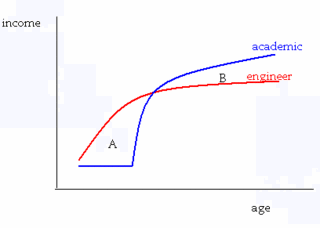 22-year-old graduate of a good physics program, given the choice between going into academia and into the business world. Academics usually do not receive tenure until their mid- to late-thirties (I was 32 when I got tenure, and that was considered quite young by most of my academic friends.) Grad school is of course a lesson in penury; a physics major entering the engineering world will have bumps in the road as s/he must change jobs, but typically fares better. At the point the grad student gains his doctorate and a tenurable job, income begins to rise. Once achieving tenure, the expected stream of income is greater still because of a decreased probability of being out of work vis-a-vis the worker in the private sector. It looks a little like this graph you see on the left. Tenure is part of the mechanism that allows for area B to compensate for area A. What John has done is to take a point on each line and compare them. It's not informative. For some people, area B must be greater than area A to induce them into academia -- these people will probably be patient in earning income and saving wealth, and perhaps more risk averse (though I don't believe risk aversion is necessary to make the story work, it's certainly sufficient.) That area B, by the way, is the basis for the expectations damages paid by universities to tenured faculty that are fired. They get only B, not the whole lost income stream, since they are required to mitigate damages by finding work elsewhere, perhaps in the private sector.
While on this point, let me add something on the nature of tenure. Tenure has been found in law to create a property right in jobs to faculty, which of course creates some perverse incentives. Many writers have argued that if you simply paid the tenured faculty off and created a different incentive structure you could get better behavior in terms of continued research output and faculty governance. But Li and Ou-Yang show that tenure doesn't seem to lead to reduced research. And there's a new paper in Economic Inquiry by Antony Dnes and Nuno Garoupa that shows how tenure may provide the correct incentives for the faculty to hire and monitor the university. Hiring new faculty often leads to an increased attention to their research over the older faculty member's research. They fall out of favor. If you do not provide them with some guarantee against falling out of favor, will they continue to hire good new faculty? And who is in a better position to decide which new PhD has a chance to do something pathbreaking -- the faculty or the administration? In essence, they argue, tenure might be a means of compensating senior faculty to incentivize monitoring honestly the talent of potential new hires.
The important point to remember is that a property right doesn't mean necessarily that a faculty member has a job for life. It simply establishes a price to buy out a lifetime contract. Faculty that misbehave in either "becoming deadwood" or in sabotaging younger faculty research can always be put out to pasture. It's simply a matter of getting the price right.
According to this site the average salary for a computer programmer in California is $65,352. Application systems analyst? $57,209. Systems and programming manager? $79,143. Information systems manager? $78,977. Director of information systems? (typically a corporate VP) $92,191. These are well within the range of salaries for tenure-track professor jobs I cited from AAUP statistics in my last post. So where is the hypothetical difference King Banaian cites, where a full prof makes 65K and needs tenure to keep from leaving for a 90K job? In California, anyhow, all these jobs pay about the same. In fact, if you�re a tenured prof at USC (let�s not even whisper about Cal Tech), you�d be taking a cut in pay to go to a 90K private sector job. Doesn�t this change King�s example? Given King's suggestion that tenure is there to overcome a pay differential, aren�t universities now overpaying their faculty if they�re throwing in tenure with this deal?Tenure is more than just compensation for a pay differential -- I'll get to that in a minute -- but it is a compensation. The mistake John makes is looking at an annual salary and comparing across job categories. This cross-sectional or latitudinal analysis takes into account only a single year of income and treats all workers within a job class as having the same other characteristics. But cross-sectional analysis to be done right must be done under the assumption of ceteris paribus -- all other things held equal. There's no correction for age, for example, and there's a fair chance that full professors are on average older than most of the job classes cited here.
I could go on, but that misses the broader point about tenure: It's all about assuring a lifetime stream of income, not a one-year event. And it's also about assuring a return on a risky investment called graduate school. Consider a
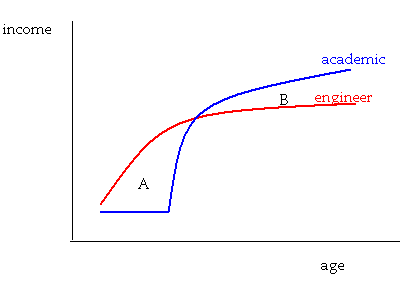 22-year-old graduate of a good physics program, given the choice between going into academia and into the business world. Academics usually do not receive tenure until their mid- to late-thirties (I was 32 when I got tenure, and that was considered quite young by most of my academic friends.) Grad school is of course a lesson in penury; a physics major entering the engineering world will have bumps in the road as s/he must change jobs, but typically fares better. At the point the grad student gains his doctorate and a tenurable job, income begins to rise. Once achieving tenure, the expected stream of income is greater still because of a decreased probability of being out of work vis-a-vis the worker in the private sector. It looks a little like this graph you see on the left. Tenure is part of the mechanism that allows for area B to compensate for area A. What John has done is to take a point on each line and compare them. It's not informative. For some people, area B must be greater than area A to induce them into academia -- these people will probably be patient in earning income and saving wealth, and perhaps more risk averse (though I don't believe risk aversion is necessary to make the story work, it's certainly sufficient.) That area B, by the way, is the basis for the expectations damages paid by universities to tenured faculty that are fired. They get only B, not the whole lost income stream, since they are required to mitigate damages by finding work elsewhere, perhaps in the private sector.
While on this point, let me add something on the nature of tenure. Tenure has been found in law to create a property right in jobs to faculty, which of course creates some perverse incentives. Many writers have argued that if you simply paid the tenured faculty off and created a different incentive structure you could get better behavior in terms of continued research output and faculty governance. But Li and Ou-Yang show that tenure doesn't seem to lead to reduced research. And there's a new paper in Economic Inquiry by Antony Dnes and Nuno Garoupa that shows how tenure may provide the correct incentives for the faculty to hire and monitor the university. Hiring new faculty often leads to an increased attention to their research over the older faculty member's research. They fall out of favor. If you do not provide them with some guarantee against falling out of favor, will they continue to hire good new faculty? And who is in a better position to decide which new PhD has a chance to do something pathbreaking -- the faculty or the administration? In essence, they argue, tenure might be a means of compensating senior faculty to incentivize monitoring honestly the talent of potential new hires.
The important point to remember is that a property right doesn't mean necessarily that a faculty member has a job for life. It simply establishes a price to buy out a lifetime contract. Faculty that misbehave in either "becoming deadwood" or in sabotaging younger faculty research can always be put out to pasture. It's simply a matter of getting the price right.